Wednesday, July 20, 2011

The Artist (2011)


Just before the holidays I heard about a new film that had had its premiere at the Cannes festival in May. Normally I don't comment on movies made after 1935 but in this case I have to make an exception. French director Michel Hazanavicius new movie The Artist is a silent movie with synchronized score and sound effects and a short scene with dialogue at the end, just like if it was made in 1928. Technically it's thus a part-talkie, but it doesn't stop at that. The story takes place in Hollywood 1927 where swashbuckling film star George Valentin is facing the arrival of the talkies. A film about the transition to talkies naturally has its place on this blog.

Unfortunately I had no possibility to attend the Cannes festival premiere and the movie does not become available to the general public until this fall so I haven't actually seen it yet, but I found this nice review by Sukhdev Sandhu in the online edition of the UK paper The Telegraph.

"Jean Dujardin plays George Valentin, a dashing and rather arrogant actor whose dynamic, swashbuckling roles in films such as A Russian Affair and A German Affair have made him a huge star of the pre-talkie era. But he’s caught off-guard by the arrival of sound: “If that’s the future, you can have it!” His roles dry up, his wife leaves him, and a move into directing doesn’t work out.

All he has left is his Jack Russell terrier and is his memories of the delightfully-named Peppy Miller (Berenice Bojo). She’s the all-smiling, high-stepping would-be actress with whom he’d fallen in love even before her career went into overdrive. They’d never done anything untoward together, but they’ve always looked at each other longingly. Now that he’s seen as “old meat”, now that he’s yesterday’s news, a relic of an abandoned art form, will Peppy still remember him? Does she still carry a flame for him?
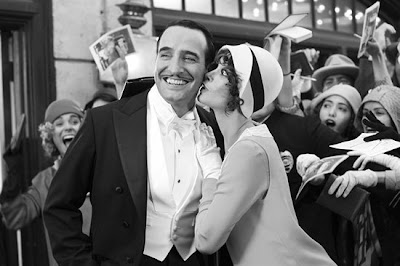


The Artist is not a film that thinks it’s superior to the movies it evokes (I was going to use the word 'pastiche', but that seems inappropriate; 'pastiche' sounds cold, a touch heartless - the very opposite of what this is). Hazanavicius has evidently immersed himself in the silent period, seeing in it liberation rather than restriction: he’s in love with its melodramatic intensity, its lack of irony, the importance it places on lighting and photography. Cinematographer Guillaume Schiffman, drawing on deathless classics such as Murnau’s City Girl (1930), makes black and white look wonderfully warm rather than austere. Ludovic Bource’s score is charming and amplified by two exquisitely clever breaks in the film’s otherwise complete eschewal of natural sounds.

Dujardin and Bojo excel together, reining in any desire to compensate for their lack of dialogue by exaggerating the physicality of their roles, and offering up some delightful dance routines too. Hazanavicius himself is wise enough not to stuff the screenplay with lots of dialogue just to placate audiences unused to watching silent; the intertitles are kept to a minimum. By the end, it’s all you can do not to cheer on the seemingly star-crossed lovers and not to sigh about how they don’t make films like this anymore. Except, of course, Hazanavicius just has."


Let's take a look at the trailer. It gives you a good idea of the style. The trailer editor's choice of music is a bit odd though. I don't see why they went for Louis Prima's swing classic Sing Sing Sing written in 1936 instead of a peppy 1928 fox-trot. But I guess you can't have it all. I will definitely watch the movie as soon as I possibly can and I advise all transition geeks to do likewise.

Thursday, June 9, 2011

Rio Rita - Lost footage found on You Tube

Original promotional material published in Film Daily in July 1929

The other day I got a mail from my friend Brian who told me about a sensational find he had made on You Tube. Someone had decided to upload two fragments from the supposedly lost 1929 version of Rio Rita. To me this is a sensation! Judging from the number of showings it has, not many people have found it yet. There is almost no information about it other than the uploader says the footage comes from a reel of film he found in an estate sale a while ago.

The two snippets Mr McClutching has posted are indeed from the original 1929 version of Rio Rita. The footage is not present in the 1932 re-release version that is in circulation today. The snippets seems to be filmed straight off a screen or a wall but look fantastic nevertheless. The film elements appears to be in almost perfect condition considering its age. The color depth looks amazing, almost too good to be true. Let's take a look at it!

The first snippet comes from the beginning of the movie where Dorothy Lee is introduced with a little number called The Kinkajou. As I understand this was the first musical number in the movie. It has been entirely removed in the 1932 version.


The second clip is a fragment from the latter half of the Sweetheart We Need Each Other reprise aboard the pirate barge. This clip comes from the massive color segment towards the end of the movie.


The beginning of the number and more information about the cut/uncut version of Rio Rita can be found in my previous post about cut musical numbers.

Watching these resurfaced fragments it becomes somewhat easier to understand why this footage was cut in the 1932 version. The most obvious reason was of course the running time. A 105 minute move was (and is) an easier sell than a 140 minute movie. But which scenes could be cut without crippling the plot too much? The easiest way was of course to cut songs as they usually don't move the plot forward. But this must have been difficult since Rio Rita was an operetta. Why was the peppy Kinkajou song cut and other slower songs saved? The Kinkajou was after all a major hit and one of the better known songs from the 1927 Broadway show. My guess is that it has something to do with the performance.

Here's a Ampico piano roll of The Kinkajou published in 1927, recorded by Ferde Grofé


In 1929 talkie musicals were something completely new. Methods of cinematography and sound engineering had not found their final form. The crew that made Rio Rita were pioneers in many ways. They had no recipe, they had to improvise.
In 1932 however the movie musical stood before its second coming. Almost every aspect in moviemaking had evolved incredibly fast during the three years between the two versions. What was groundbreaking in 1929 was not even yesterdays news in 1932.

My guess is that most of the cut material in Rio Rita was considered old-fashioned. Let's face it, Dorothy Lee was adorable in almost every way, but her rendition of The Kinkajou seems a bit clunky and the choreography isn't exactly top notch. The staginess of parading chorus girls walking up and down stairs in the second fragment is very 1929 but had no place in 1932. The 1932 audience was experienced and probably found Rio Rita quite dull even after it had been "modernized". Let's hope these fragments ends up in a complete 1929 version soon. Until then, it feels great knowing they exist and appears to be in great shape.


The 1929 trailer for Rio Rita

Saturday, April 2, 2011

A stolen waltz

In 1929, when the talkies flooded the world, all the musicals produced had to be filled with songs. Naturally all these musicals became a fantastic opportunity for aspiring songwriters to get recognition. Sometimes the songs were brilliant, sometimes not. The music publishers quickly hired songwriters who wrote songs more or less off the cuff. The need for songs seemed never ending. Inspiration wasn't always at hand, so some of the songwriters recycled chord progressions and even parts of melody that had worked before, if only to get a song placed. The songs at this time had to fit the three minute limitation of a record, the radio and now the talkies. Basically, a quite strict template for hit songs was created. This template would be used more or less untouched until the advent of Television and Rock'n'Roll.

Many of the late silents and early talkies indeed included some brilliant songwriting. Many of the songs became evergreens even if the film it was performed in quickly fell into oblivion. One of the most popular types of theme songs in the late 20's was the romantic waltz. Ramona, Diane, Charmaine, Coquette to name a few, almost every film had one. The theme song was often performed throughout the picture in many different versions and styles just to show off how versatile it was. Very often it was even turned into a snappy fox-trot. The goal was of course to induce it as much as possible to get it to stick properly with the audience. It was important to get a hit song. With the increasing output it became more and more difficult to tell which songs would work the best. Sometimes publishers were even lurking outside the theatres just to pick up which songs people were humming when leaving.


The theme song in Our Dancing Daughters in 1928 was no exception to the rule. I Loved You Then As I Love You Now, written by the team Axt-Mendoza-MacDonald is perhaps not well remembered today but it’s still a very efficient song that is very characteristic. There are several 1928 recordings of it so it was definitely a hit back then. Here is the fox-trot rendition of it from the party scene in the movie:

The chorus works rather well as a fox-trot even if it was conceived as a waltz. If we slow down the tempo a bit, change the meter to ¾ and attach the verse, in its original form it sounds like this, performed by Louis Wick:
Our Dancing Daughters was released early September 1928 in the US. It was a silent movie but it had a rather elaborate soundtrack, still not synchronized but it included some off camera dialog.
Now we fast forward about six months. The young Swedish songwriter Jules Sylvain was hired to write some songs for the first Swedish talkie Säg Det I Toner (Say It With Songs) in the summer of 1929. Sylvain had seen The Singing Fool in Berlin late 1928 and immediately understood where it all was heading. According to Sylvain's memoirs the occasion was not only the first time he saw a talkie but also the premiere of talkies in Europe all together. On his return to Stockholm he immediately started lobbying for Swedish talkies. Naturally he saw the opportunity to promote his own songwriting. So when SF, the leading studio finally decided to make a talkie it was quite obvious which composer to hire for the project.


However, Sylvain apparently had trouble finding appropriate songs for the picture. He even admits it in his memoirs. After all he had no experience writing for movies. To get the hang of it he saw as many talkies he possibly could. When shooting was to begin he was over in London where it was much easier to catch a talkie than I Stockholm where only one cinema had installed a Vitaphone system.

This might sound controversial but I think he must have seen Our Dancing Daughters sometime during the summer of 1929 and contrary to the official story he more or less nicked the theme song from it to use in “his” film. Judge for yourself but I think the similarities are apparent.
Sylvain’s theme song to Säg Det I Toner is in the same key, the verse has basically the same melody and the general feel of the songs are very much alike even if the chorus is different in the Swedish song. I'm sure he thought the original was a great waltz and believed he would get a away with murder borrowing parts of it. Actually, I think he did!

Sylvain wasn't the only one who borrowed stuff from fellow composers. Here's another example, not as evident but every time I hear one of these songs I always sing the melody to the other one on top just because it can be done, well almost.

Tip-Toe Through The Tulips With Me (Burke-Dubin) From Gold Diggers Of Broadway (1929)
Performed by Nick Lucas and chorus.


Everyone Says I Love You (Kalmar-Ruby) from Horse Feathers (1932)
Performed by The Marx Bros.


A special thank you to Aubyn/Rachel at The Girl With the White Parasol presenting me with a Stylish Blogger Award!

Related Posts with Thumbnails