

The cover of the May 1920 issue of Saturday Evening Post
in which Fitzgerald's short story first was published
When F. Scott Fitzgerald published his short story Bernice Bobs Her Hair in the May 1920 issue of Saturday Evening Post, little did he know about the stir it would provoke. Up until this time, long, glorious, pampered hair was a key component of traditional feminine beauty. The idea of bobbed hair, which came into style after the first world war was considered scandalous and, as Bernice herself jokingly comments in the short story, even "unmoral". The fact that a simple hair cut could so upset an entire town may seem ludicrous to us now, but if we consider it in the context of the changing social period Fitzgerald lived in, it makes more sense. Long hair represented both a woman's beauty and her virtue – and bobbing one's hair simply wasn't seen as something a respectable, well-bred girl would do.
Enter the flapper. I will not turn this post into a feminist manifesto but some events were crucial for the flapper to appear like Phenix from the flames. The first world war forced the women out of the house and into society. With the right to vote - the modern woman was born. Suddenly women had an independency they never had experienced before. With this independence also came the desire to express their personalities in a new way. The women freed themselves from bustles and corsets, cumbersome attire which in many ways had been a prison sentence of about 500 years for all womanhood. Skirts went up, knees were shown and the long glorious hair was cut off.

Enter the flapper. I will not turn this post into a feminist manifesto but some events were crucial for the flapper to appear like Phenix from the flames. The first world war forced the women out of the house and into society. With the right to vote - the modern woman was born. Suddenly women had an independency they never had experienced before. With this independence also came the desire to express their personalities in a new way. The women freed themselves from bustles and corsets, cumbersome attire which in many ways had been a prison sentence of about 500 years for all womanhood. Skirts went up, knees were shown and the long glorious hair was cut off.

A flapper gets a haircut.
Illustration by John Held j:r (Life Magazine, 1926)
The first actress who adopted the new style on a broad scale was Colleen Moore. She was born Kathleen Morrison 1900 (some sources say 1902) in Port Huron, Michigan. Her family later moved to Florida and that's where she grew up. The family summered in Chicago, where young Kathleen nourished her acting dreams in the company of her Aunt Lib (Elizabeth, who perhaps inspired by the times had changed her name to "Liberty" Lib for short) and her uncle Walter Howey. Howey was an important newspaper editor in the publishing empire of William Randolph Hearst, and he was the inspiration for Walter Burns, the fictional Chicago newspaper editor in the play and the 1931 Lewis Milestone film The Front Page.
Somehow uncle Walter knew D.W. Griffith and Aunt Lib had him arrange a meeting with Kathleen who had decided she wanted to go Hollywood at age 15. Griffith agreed to a screen test to see if her eyes (one brown, one blue) would photograph close enough in darkness as not to be a distraction. Her eyes passed the test, and so she left for Hollywood with her grandmother as chaperon and her mother along as well. Her name was changed to Colleen Moore and she debuted as such in The Bad Boy in 1917. Colleen was a smart girl and slowly moved up in the budding studio system. She proved to have great comic timing and got gradually bigger and better parts. Her big break came in First National's Flaming Youth (1923).

The poster for Flaming Youth (1923)
In Flaming Youth Colleen plays a vivacious flapper and had to cut her hair short to fit with the image. The idea for how it should be carried out is almost too simple to be true. In her autobiography Silent Star, published in 1968 Colleen tells us all about it. Her mother had a Japanese doll which she loved dearly and simply suggested that Colleen cut her hair to resemble it for the role as the flapper. Colleen agreed and the result is history.
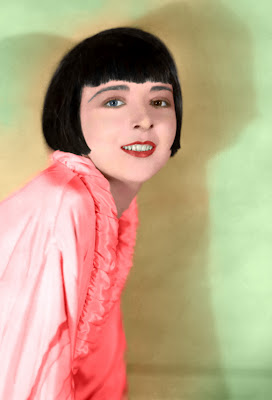

Colleen Moore 1927
Flaming Youth made both Colleen Moore and her haircut overnight superstars. As important a film Flaming Youth was for the Jazz Age, as sad is the loss of it for us today. Only one reel of it is reported to exist in a vault somewhere.
Colleen Moore is one of those screen legends that is almost totally forgotten today because most of her movies are lost. Of her about 60 movies we only have a little more than a handful left to enjoy. One of them is Ella Cinders from 1926, a wonderful "modern day" Cinderella tale where Colleen makes good use of her comic talent and striking looks. Here's a clip from it. Please enjoy Collen Moore at the height of her career:
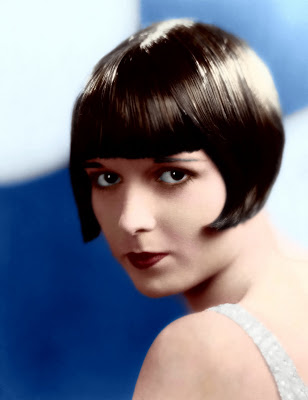
The bobbed Japanese doll haircut soon became synonymous with the flapper image and was copied by girls all over the world. One actress who took this hairstyle to another level was of course Louise Brooks, who used it to charge her appearence with allure and enigma. But she didn't bob her hair until 1926.
Colleen Moore is one of those screen legends that is almost totally forgotten today because most of her movies are lost. Of her about 60 movies we only have a little more than a handful left to enjoy. One of them is Ella Cinders from 1926, a wonderful "modern day" Cinderella tale where Colleen makes good use of her comic talent and striking looks. Here's a clip from it. Please enjoy Collen Moore at the height of her career:
The bobbed Japanese doll haircut soon became synonymous with the flapper image and was copied by girls all over the world. One actress who took this hairstyle to another level was of course Louise Brooks, who used it to charge her appearence with allure and enigma. But she didn't bob her hair until 1926.

Louise Brooks 1929
Both Colleen Moore and Louise Brooks left their incredibly successful silent movie careers around 1930. Colleen made her last film as Hester Prynne in a poverty row production of The Scarlet Letter in 1934. She married a stock broker and learned how to invest her fortune. At the height of her fame, Moore was earning $12,500 per week. She was an astute investor, and through her investments remained wealthy for the rest of her life. Throughout her life she had a fascination for dolls (probably also their haircuts). Over the years, starting in her childhood she spent a fortune on a gigantic dollhouse, a fairy castle which still can be visited at The Museum Of Science and Industry in Chicago. In the 1960's she ran a television production company together with King Vidor. In her later years she would frequently attend film festivals, and was a popular interview subject always willing to discuss her Hollywood career. She was a participant in the 1980 documentary film series Hollywood, providing her recollections of Hollywood's silent film era. Colleen Moore left us in 1988, probably aged 87.
Louise Brooks hit the silver screen for the last time in 1938 with the forgettable western Overland Stage Riders. Contrary to popular rumor, this was not intended to be her "comeback" to Hollywood, she made it simply because she needed the money. She then opened a dance studio in Beverly Hills. It failed because of a financial scandal involving her business partner. In 1940, Brooks boarded a train back to Kansas, leaving Hollywood for good. She opened a dance studio in Wichita and wrote a book, "The Fundamentals of Good Ballroom Dancing". She later became a quite successful writer and painter. Louise Brooks left us in 1985, aged 78.
Let's end with a citation from the writer who started it all:
Louise Brooks hit the silver screen for the last time in 1938 with the forgettable western Overland Stage Riders. Contrary to popular rumor, this was not intended to be her "comeback" to Hollywood, she made it simply because she needed the money. She then opened a dance studio in Beverly Hills. It failed because of a financial scandal involving her business partner. In 1940, Brooks boarded a train back to Kansas, leaving Hollywood for good. She opened a dance studio in Wichita and wrote a book, "The Fundamentals of Good Ballroom Dancing". She later became a quite successful writer and painter. Louise Brooks left us in 1985, aged 78.
Let's end with a citation from the writer who started it all:
"I was the spark that lit up Flaming Youth, Colleen Moore was the torch. What little things we are to have caused all that trouble"
- F. Scott Fitzgerald.
The title picture of this blog is a poster for the 1927 movie Twinkletoes starring Colleen Moore.


 Posts
Posts


