Showing posts with label Color. Show all posts

Thursday, November 17, 2011

Mamba at the Astor in Melbourne - Part 2

This post is continued from last weeks post about the Mamba world premiere at The Astor in Melbourne on Nov 21 at 8pm.

In the first post I wrote about Mamba's and Tiffany Pictures historical background. In this post I will write about the actors in the leading roles of the film. Unfortunately they are almost forgotten today, at least if you compare them to superstars like Garbo or Gable.

Mamba was very well received by the audience as well as by the press.  Tiffany had made sure the film would become a smash hit by hiring some of the most prominent actors at the time for the lead parts.

Jean Hersholt 1927
August Bolte - Jean Hersholt
Jean Hersholt was born in Copenhagen, Denmark in 1886, the son of Clair and Henry Hersholt, both actors at the Danish Folk Theatre. From an early age young Jean went on tour performing with his family all over Europe. Back at home in Copenhagen he went to art school and soon got recognition for his fine pencil drawings.
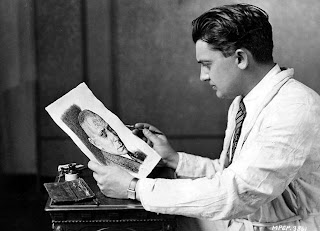
Hersholt drawing von Stroheim (1923)
But it was the acting that really got him. After some years at the art school he went on to acting school at the Dagmar Thaatre in Copenhagen. In 1906 he had roles in three of the earliest films produced for the Danish market. Those were all short comedies, very typical of the times. At 22, in 1908 he left Denmark for Canada and settled down first in Montreal then on to New York. In 1914 he left New York for Hollywood. In 1915 he was hired as responsible for the Danish pavilion at the Pan Pacific exhibition in San Francisco. It was at this time he met Thomas Ince, a Hollywood producer and director. Ince soon realized Hersholt was made of the right stuff and hired him as one of his regulars. Hersholt played in most of Inces films 1918-22. He even got to direct some of the films he played in. Ince is mostly known today because of the scandal surrounding his death in 1924 when he suposedly was killed aboard W.R. Hearst’s yacht.
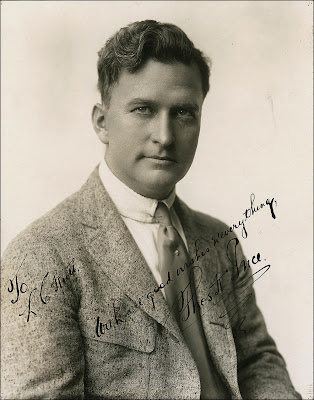
Thomas Ince
Hersholt’s career took a big leap in 1922 when he got one of the leading roles in John S. Robertson’s Tess of The Storm Country with Mary Pickford. Then on to von Stroheim’s giant epic Greed, in which he played Marcus Schouler, the villain. Showing he was capable to shine in almost any role given to him he quickly became a regular first at Goldwyn and Paramount and later at MGM.
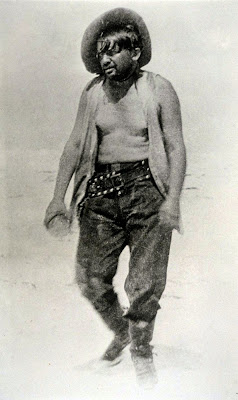
Greed (1924)
Hersholt made the transition to talkies without any difficulties, his Danish accent was no problem. With the arrival of the talkies his roles shifted from villains to caring father figures, teachers and European noblemen. At MGM he had big supporting roles in prestige productions like Grand Hotel (1932) and Dinner At Eight (1933). He was Shirley Temple’s grandfather in Heidi (1937).
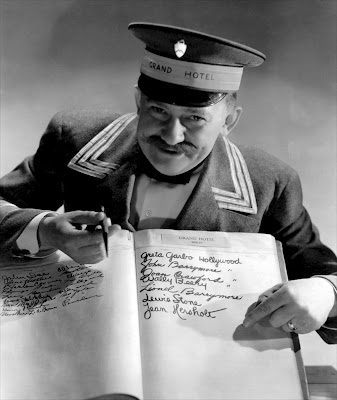
Grand Hotel (1932)
But it was the role as a doctor that would provide a continuing vehicle for Hersholt and something of a fateful direction for the actor. The mid-30s were abuzz with the births of the Dionne Quintuplets in Canada. Hollywood jumped on, highlighting the story and the officiating obstetrician, Dr. Dafoe, who was translated into Dr. John Luke, in The Country Doctor (1936). Hersholt brought the right ingredients to the part of Luke and two years later a sequel followed, Five of a Kind (1938). Hersholt was enthusiastic about a series of movies, but Dafoe himself blocked this idea. Nevertheless, in 1937 Hersholt had already germinated a new radio series to continue portraying a dedicated and kindly small town doctor. For a character name Hersholt turned to his most beloved author, his countryman, literary light Hans Christian Andersen, for a name-Dr. Christian. It was a hit and, and he convinced RKO Radio Pictures to bankroll a series of six Dr. Christian films (1939-41). The radio series stayed on the air every week for 17 years, about 800 episodes.


In the early 1940's Hersholt more or less left the movies but stayed in the business working with many different charity projects. In 1939 he funded The Motion Picture Relief Fund, an organization that helped to support industry employees with medical care when they were down on their luck and was used to create the Motion Picture Country Home and Hospital in Woodland Hills, CA. This led to the creation in 1956 of the Jean Hersholt Humanitarian an honorary Academy Award given to an "individual in the motion picture industry whose humanitarian efforts have brought credit to the industry". Hersholt was President of the Academy of Motion Picture Arts and Sciences 1945-49. Another lesser known function he had was as Chairman of the Hollywood chamber of commerce in the early 1950’s and as such he helped negotiate the rights for the Scandinavian Airlines transatlantic flights in 1954. He was very proud of being Danish, throughout his life he helped spread Danish and Scandinavian culture to the world. One of his major achievements was translating all of Hans Christian Andersens stories to the English language. His translations are still regarded as the best.
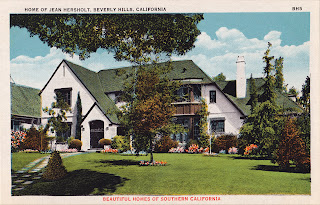
Jean Hersholt's home in Hollywood
Jean Hersholt made 443 films, got two honorary Oscars and is one of few who has two stars at the Hollywood walk of fame. One for his contributions to Motion Pictures, the other for his extensive radio work. Jean Hersholt died of pancreatic cancer in 1956, only months after having introduced Dr Christian to TV.
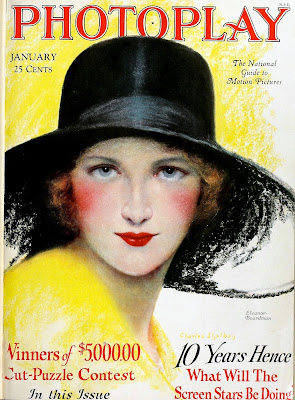
Eleanor Boardman - Photoplay January 1928
Helen von Linden - Eleanor Boardman
Born in Philadelphia 1898 to strict, Presbyterian parents. After graduation from The Academy of Fine Arts in her home town she left for New York hoping for a career on Broadway. When that didn’t work out as expected, she became a model for Kodak. This worked out splendidly and she eventually became the official Kodak Girl. With her face on posters all over the country she was of course hoping for some movie mogul to spot her and take her to Hollywood.

Eleanor Boardman early in her career
After some time as Kodak girl she heard that the Selwyn Organization, a major producer of Broadway plays, was looking for girls with no stage experience. Since she was more than qualified in that respect, she tried out for the job and before she knew it she was in the chorus line of a production called "Rock-a-Bye-Baby" until the show closed three months later. Unfortunately she caught laryngitis and temporarily lost her voice, making it difficult to continue on the stage. It was at this time that a casting director for Goldwyn Pictures hit the Broadway scene looking for new faces. She tested for him and impressed him enough that he finally picked her out of a pool of more than 1000 young girls who tested for the opportunity to go to Hollywood.
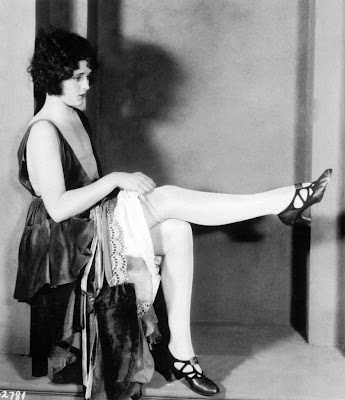

Well in Hollywood followed months of fruitless effort until one day Rupert Hughes saw her riding a horse and gave her a part in a film and she quickly began to attract audiences. She was chosen by Goldwyn Pictures as their "New Face of 1922", through which she signed a contract with the company. After several successful supporting roles, she played the lead in 1923's Souls for Sale. Her growing popularity was reflected by inclusion on the list of WAMPAS Baby Stars in 1923. Her contract was renewed in 1924 when Goldwyn merged with Metro and became MGM.

Souls For Sale (1923)
She appeared in fewer than forty films during her career, achieving her greatest success in Vidor's The Crowd in 1928. Her moving performance in that film is widely recognized as one of the outstanding performances in American silent films. She ultimately stayed with MGM until 1932. Boardman retired in 1935, and retreated completely from Hollywood and public life. Her only subsequent appearance was in an interview filmed for the Kevin Brownlow and David Gill documentary series Hollywood in 1980.

With James Murray in The Crowd (1928)
1926-31 Boardman was married to the film director King Vidor, with whom she had two daughters, Antonia born 1927, and Belinda born 1930, just before shooting of Mamba started . In September of 1926 fellow actors John Gilbert and Greta Garbo had planned a double wedding with them, but Garbo broke off the plans at the last minute. Boardman's second husband was Harry d'Abbadie d'Arrast to whom she was married from 1940 until his death in 1968. She died in Santa Barbara, California at the age of 93.
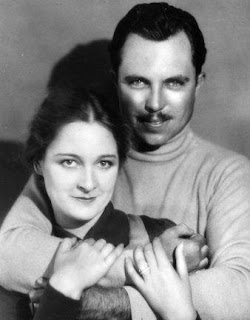
Eleanor Boardman and King Vidor
Eleanor Boardman has a star on the Hollywood Walk of Fame for her contributions to Motion Pictures.
Mamba was her first talkie and the only film she made in color.

Ralph Forbes by Clarence Sinclair Bull (1928)
Lieutenant Karl von Reiden - Ralph Forbes 
There is a lot of confusion about Forbes birth date. The date varies from 1896, 1901 to 1904. According to the Civil registration records in the UK, September 30, 1904 is the correct date. Born in an acting family in London, England. Both his parents and little sister were stage actors so the choice of profession might have been easy for young Ralph. He started his career on stage as a teenager in London. This led to some roles in British films, among them the early color movie His Glorious Adventure, shot in Prizmacolor 1922, and also a Swedish version of Charley's Aunt shot in England and Sweden between 1922-26 before leaving for Hollywood in 1926 to play fellow Englishman Ronald Coleman's brother in the Paramount big budgeter Beau Geste.

Beau Geste (1926)
In 1924 Forbes married the celebrated Broadway actress Ruth Chatterton who was eleven years his senior. The couple settled down in Hollywood and Chatterton soon also made her debut on the silver screen.
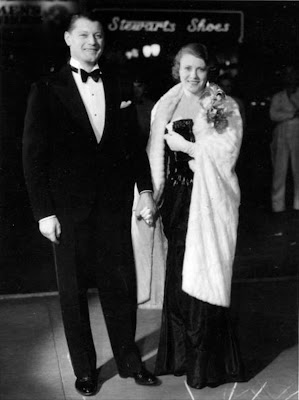
Ralph Forbes and Ruth Chatterton
Forbes striking looks made things easy and he got quite important roles almost immediately. He was cast against many of the biggest names right from the start. Norma Shearer, Lon Chaney, Dolores Del Rio, Clara Bow, Corinne Griffith and so on.
Forbes and Clara Bow in Her Wedding Night (1930)
Ralph Forbes was perhaps not one of the bigger names in Hollywood, some might even describe him as an MGM bit player, but considering he made about five films a year throughout the 30's and who he made those films with I think it's fair to call him a true movie star.
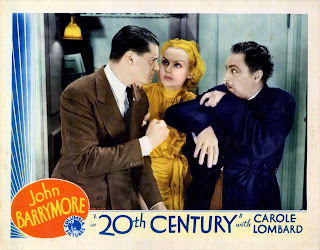
Forbes about to hit John Barrymore in the face in 20th Century (1934)
Forbes and Chatterton divorced in 1932. Forbes Movie career basically ended in the early 40's but got some new life with the arrival of TV and the Playhose series. In 1951 Forbes fell ill and passed away far to early, he was 46.
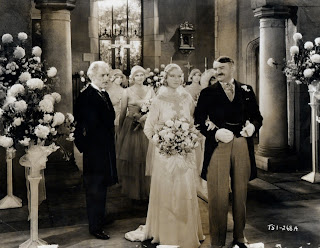
Eleanor Boardman and Jean Hersholt in Mamba
Mamba is a phenomenal early all color talkie that deserves its place in Movie history. Come see for your self and have a chat with me on Monday night at the Astor in Melbourne. Tickets are still on sale!

Friday, November 4, 2011

Mamba World Premiere in Melbourne Nov 21


It's not without pride I can announce that Tiffany Pictures 1930 all color triumph Mamba will be shown in public for the first time in about 80 years. This very special event will take place at The Astor Theatre in Melbourne, Australia November 21.

My collaborator Paul Brennan and I will be there in person to present the film together. It was Paul who found the long thought lost nitrate reels in 2009, I then edited the whole thing together into a presentable format. Since 2009, when Mamba was found, the complete soundtrack has been added to the film elements thanks to a kind contribution from the UCLA Film & Television Archives.

With all the different elements in place Mamba is now ready to be properly restored. However, when the opportunity to present the film before a live audience came about, and at such a wonderful place as The Astor we immediately decided to share this remarkable discovery even though it's still a work in progress.


"The Astor was built in the 1930s and still retains the art-deco charm of that period. The theatre is a classic, single-screen cinema with stalls and a dress circle, the overall seating capacity of 1,150 is reduced from the original 1,700 - and the auditorium has the same, soft ambience that you will have enjoyed in the foyers. Beautiful curtains cover the screen - there are no jarring, advertising slides to greet you!


But there is nothing "old-fashioned" about The Astor's facilities. The fully air-conditioned cinema boasts a state-of-the-art sound system and now has Australia's first installation of the superb, Barco 4K Digital Projector which is capable of providing resolution that is up to four times higher than the industry standard." Thus a splendid venue for such an important event.

This is the first of two articles about Mamba, it's importance in film history and more information about the people who made it. The story about how the film was found can be found here.


Mamba is one of the earliest all talking all color features ever made that also survives complete. The use of color throughout an entire talking feature was something completely new in 1929 and for such a small studio as Tiffany it was unheard of. It’s clear Tiffany decided to take a risk with hopes to become a bigger player in the Hollywood studio system. In the fall of 1929 Hollywood was not only a turmoil of sound but also color. Every studio of note was wiring for sound and the bigger players also wanted color in their productions, if only just short sequences.

One should note that at this time only about a dozen Technicolor cameras were available in Hollywood altogether. The studios had to battle to use them and the schedules were tight. The big studios monopolized the color cameras quite thoroughly but Tiffany got lucky, probably by some sort of divine intervention and could shoot an entire feature in color. All color talkies was clearly the next big thing and Tiffany decided to go all in right from the start. They were even planning to take technology a step further and shoot it in 3D according to this article in the Film Daily published Nov 12, 1929


Mamba was shot during approximately 10 weeks, from the end of September to early December 1929. At the time production begun, only two all talking, all color features had been released. Those were two backstage musicals from Warner Bros, On With The Show! released in July and Gold Diggers of Broadway in late August. None of the two have survived intact.

 When production wrapped in December, two more WB musicals were ready for release. The two hour extravaganza The Show Of Shows opening late November and the Jerome Kern operetta Sally starring Marilyn Miller just before Christmas 1929. These two have survived in black and white only, save from short fragments in color.


The fifth all color talkie The Vagabond King from Paramount had its NYC gala premiere late February 1930 (it wasn’t released to the general public until April). It has survived and has been restored by UCLA. Then comes Mamba, released March 10, which makes it the sixth all color talkie ever produced, and the earliest known all color talkie that wasn’t a musical or came from a major studio. It is intact and in quite good shape but it needs to be restored.


Tiffany Pictures was formed in 1921 as an independent production company by silent superstar Mae Murray and her then husband and director Robert Z. Leonard. Probably inspired by United Artists, formed two years earlier by Pickford/Fairbanks/Chaplin/Griffith, Tiffany's main goal was to produce Mae Murray vehicles, distributing them through Metro. After having made eight features together, Mae Murray divorced Leonard and left Tiffany for MGM in 1925. She eventually came back to Tiffany in 1929 to remake her 1922 success Peacock Alley as a talkie. It didn't work out well and Murray's talkie career was more or less over within a year. She sued Tiffany accusing the company having ruined her career. She lost the case and eventually left the movie business. The rest of her life is a mentally unstable, rather sad story. Mae Murray left us in 1965, a year after her last attempt for a come-back at 75. She was the real Norma Desmond.

Mae Murray in The Merry Widow 1925
What happened to Tiffany Pictures right after Murray's departure is somewhat unclear. My guess is that it was in limbo for a while until someone decided to pick up the pieces. There are indications of Tiffany being reformed from the scraps of the MGM merger in 1924. Considering its close relationship with Metro, many redundant people left over from Metro (and Goldwyn) who wasn't transferred to MGM was probably hired by Tiffany. With a new management and a staff of skilled craftsmen the company was ready for big business.

Tiffany is often referred to as a poverty row studio. I'm not sure if the term poverty row is a correct label for a company like Tiffany. I think independent studio would be more suitable. After all, they had their own studio from 1927, The Reliance Majestic Studios which had been the home of DW Griffith. The Birth of a NationIntolerance and Broken Blossoms were all partially or fully shot at the studio.

The Tiffany-Stahl Studio 1929 
Poverty row units normally had to lease facilities, often cameras and other equipment, sets and sometimes even actors from other studios when they wanted to make a picture. The classic poverty row production was generally a poorly funded venture with very unclear distribution. In an era when the bigger studios also owned the major theatre chains, getting an independent picture into movie houses was a challenge. I guess the Tiffany studio may have served as a base for other smaller companies, thus linking it to the poverty row epithet.

With the acquisition of the Reliance Majestic in 1927 came the new boss the MGM director and producer John M. Stahl who stayed in power until 1930 when he sold his interest in Tiffany and became a director at Columbia. I guess Stahl was largely responsible for the "New expanding Tiffany" as it coincides exactly with his time as CEO. Stahl was generally considered a really competent and nice man, liked by both staff and actors.

From August 1929 Tiffany had a very lucrative agreement with RCA. The deal was very straight forward - If a cinema owner agreed to book a block of 26 Tiffany films, RCA would wire the theatre for sound for $2,995, which was a bargain for most managers. By February 1930 no less than 2,460 theaters had signed up for the deal. Tiffany had thus a distribution network, at least for a while.

John M. Stahl
After Stahl left Tiffany in 1930 the company sunk back among the B-players concentrating on westerns, shorts and cheap monkey movies. They finally went out of business in 1932, much because of the ongoing depression, a general lack of funds and a hard time getting their films out to the theaters. According to my sources the main reason for their demise was because "they had no profitable distribution network." So I guess the departure of Stahl also ended the profitable RCA distribution agreement. The studio was sold and the main part of the Tiffany legacy, including most of the original negatives went up in smoke during the filming of Gone With The Wind in 1939.

John M. Stahl later directed several great pictures for Columbia in the 1930's and later for 20th Century Fox, his best known film is the brilliant Technicolor noir Leave Her To Heaven. 1950's melodrama master Douglas Sirk remade no less than three of Stahls pictures from the 30's. Magnificent Obsession is one of them.

My next post will give you more Mamba magic. Stay tuned!


Thursday, June 9, 2011

Rio Rita - Lost footage found on You Tube

Original promotional material published in Film Daily in July 1929

The other day I got a mail from my friend Brian who told me about a sensational find he had made on You Tube. Someone had decided to upload two fragments from the supposedly lost 1929 version of Rio Rita. To me this is a sensation! Judging from the number of showings it has, not many people have found it yet. There is almost no information about it other than the uploader says the footage comes from a reel of film he found in an estate sale a while ago.

The two snippets Mr McClutching has posted are indeed from the original 1929 version of Rio Rita. The footage is not present in the 1932 re-release version that is in circulation today. The snippets seems to be filmed straight off a screen or a wall but look fantastic nevertheless. The film elements appears to be in almost perfect condition considering its age. The color depth looks amazing, almost too good to be true. Let's take a look at it!

The first snippet comes from the beginning of the movie where Dorothy Lee is introduced with a little number called The Kinkajou. As I understand this was the first musical number in the movie. It has been entirely removed in the 1932 version.


The second clip is a fragment from the latter half of the Sweetheart We Need Each Other reprise aboard the pirate barge. This clip comes from the massive color segment towards the end of the movie.


The beginning of the number and more information about the cut/uncut version of Rio Rita can be found in my previous post about cut musical numbers.

Watching these resurfaced fragments it becomes somewhat easier to understand why this footage was cut in the 1932 version. The most obvious reason was of course the running time. A 105 minute move was (and is) an easier sell than a 140 minute movie. But which scenes could be cut without crippling the plot too much? The easiest way was of course to cut songs as they usually don't move the plot forward. But this must have been difficult since Rio Rita was an operetta. Why was the peppy Kinkajou song cut and other slower songs saved? The Kinkajou was after all a major hit and one of the better known songs from the 1927 Broadway show. My guess is that it has something to do with the performance.

Here's a Ampico piano roll of The Kinkajou published in 1927, recorded by Ferde Grofé


In 1929 talkie musicals were something completely new. Methods of cinematography and sound engineering had not found their final form. The crew that made Rio Rita were pioneers in many ways. They had no recipe, they had to improvise.
In 1932 however the movie musical stood before its second coming. Almost every aspect in moviemaking had evolved incredibly fast during the three years between the two versions. What was groundbreaking in 1929 was not even yesterdays news in 1932.

My guess is that most of the cut material in Rio Rita was considered old-fashioned. Let's face it, Dorothy Lee was adorable in almost every way, but her rendition of The Kinkajou seems a bit clunky and the choreography isn't exactly top notch. The staginess of parading chorus girls walking up and down stairs in the second fragment is very 1929 but had no place in 1932. The 1932 audience was experienced and probably found Rio Rita quite dull even after it had been "modernized". Let's hope these fragments ends up in a complete 1929 version soon. Until then, it feels great knowing they exist and appears to be in great shape.


The 1929 trailer for Rio Rita

Wednesday, May 12, 2010

Color in the movies - Part 2 - Chronochrome

The additive color processes were many and all fairly alike. The basic principle of an additive color system consisted of black and white film stock that was treated with some sort of filters or sequence of filters when shot and up on projection the same filters were applied. Most of the problems with the different processes boiled down to getting the colored filters in perfect sync with the running film. While Kinemacolor had some success it wasn't the best looking additive color system. From a technical point of view it had quite a few shortcomings, most notably the irritating flicker and the limited color spectrum it offered. The best looking and probably most advanced additive color process was French inventor Léon Gaumont's Chronochrome, patented February 11, 1911. Chronochrome was a three-color system where the three different color images were shot simultaneously rather than in sequence. The camera was equipped with three lenses and three filters, blue, red, green. The resulting positive was then projected by a machine also equipped with three lenses and filters.
Léon Gaumont
Léon Gaumont was born in Paris 1864. He grew up in a family of humble origins. His mother was a maid and his dad a Paris cab driver. In 1876 young Léon had the oppportunity to enter the Collège Sainte-Barbe, probably with the financial assistance of his mother’s employer, the countess of Beaumont. He was forced to leave school at the age of 16 when his parents separated. Gaumont continued educating himself by attending classes at different public Paris institutions. In 1888 Gaumont married Camille Maillard, who brought as her dowry a piece of land on the rue des Alouettes, near the Buttes Chaumont, the eventual site of the Gaumont studios and of the 'cité Elgé'. When Gaumont was offered a job at the Comptoir géneral de photographie in 1893, he jumped at the opportunity. His decision proved fortunate when two years later he was given the chance to acquire the business. In August 1895, he partnered with Gustave Eiffel (the creator of the tower), the astronomer Joseph Vallot and the financier Alfred Besnier to make the purchase. Their business entity, called L. Gaumont et Cie, has survived in one form or another to become the world's oldest surviving film company extant. The company sold camera equipment and film, but in 1897 inaugurated a motion picture production business. Initially, Gaumont made films for the picture arcade business such as those operated by the Lumière brothers, but it was under the direction of Alice Guy, originally Gaumont's secretary made head of production that they began making short films based on narrative scripts.
Alice Guy
Alice Guy is considered to be the first filmmaker to systematically develop narrative filmmaking. She was also one of the pioneers in the use of sound recordings in conjunction with the images on screen in Gaumont's Chronophone system, which used a vertical-cut disc synchronized to the film. An innovator, she employed special effects, using double exposure masking techniques and even running a film backwards. Alice Guy pretty much set the standards for what could be done technically at the time. More about the Chronophone system and an example of Alice Guy's phonoscenes can be found here . She left Gaumont in 1906, before most of the experiments in color film took place. In papers found after his death Leon Gaumont described the Chronochrome process like this:
“Each image appearing on the screen in natural colors was formed by superimposition of three images, violet, green and orange. The combined radiation of these three colors results in the reproduction of natural colors. The image was photographed on the film by three objectives placed one above the other, each provided with a glass color filter. These three images were were projected in superimposition through carefully aligned objectives and filters. In this process the single image of ordinary motion pictures is replaced by three images simultaneously projected and superimposed. If these three images had the same dimensions as used in ordinary motion pictures, 18 by 24 mm each, each scene would require three times the length of film ordinarily used, and would necessitate very rapid movement of the film. Therefore, it was decided to reduce the height of the film by one quarter. By this method, the film length was approximately two and one-half times that of ordinary film.” Three images in different colors would thus overlap on the screen. A servo engine installed on the projector would correct parallax problems. The chronochrome frame measured only 12 mm in height (the standard was 18 mm), which resulted in a panoramic format on the screen. The purpose of the truncaded height of the image was purely economical as less film were used because of this. Three frames were shot on the same space as two with normal height. One could argue that the dimensions of the Chronochrome image was a forerunner to wide screen film of later years. The most fascinating thing about the Chronochrome process is that it still looks so good. Let's take a look at some of the Chronochrome films which was included in the first public presentations of the system. Ten short films were showed before an amazed audience in Paris, November 15 1912. It was a great success. In June 1913 the system was ready for export and thus presented in New York. The New York show contained slightly different snippets than the Paris showing and contained 16 scenes. To really show off the possibilities of the system both showings started with studio shots of flower and fruit arrangements. The next segment showed what 1912 French beach life was like. In this clip there's also some footage used in the New York presentation. The Carnival in Nice, early spring 1913, some shots of Venice and a military parade in Berlin celebrating the wedding of Princess Victoria Louise of Preussia and Ernest Augustus Duke of Cumberland in May 1913. At the outbreak of the first world war the Chronochrome and many other techincal innovations were either completely forgotten or put on hold. This snippet was shot at the Victory parade in Paris July 14,1919 and is one of the last scenes filmed in the process before it was finally abandoned in the early 1920's.

Thursday, March 18, 2010

Color in the movies - Part 1 - Kinemacolor

Since my second child, my beautiful daughter Juni was born January 22 there has been little time left for writing. Now things are slowly finding their tracks and new routines are being created. Uninterrupted sleep really does wonders for the creativity!

This is thus part one of a series I have planned for a long time. Many people seems to believe the first color feature was Gone With the Wind in 1939 which of course is untrue. In the series I will try to explain and show examples of some of the early color systems, all of them predecessors to 3 strip Technicolor (the system that was used in GWTW). I will try to leave out most of the technical details and concentrate on the basic principles in each system. Enjoy!


”3D films will be the next big thing”. It sounds familiar, doesn’t it? I wonder if this modern day tagline was used in September 1922 when the first known 3D film opened. The film was called The Power of Love and was shot with a modified Prizma color camera. Prizma color was a primitive color system that was invented in 1913, but color movies were of course yesterdays news even in 1913.

The first successful color motion picture process was Kinemacolor. From the start it was a three color system. The roots of the system dated back to the work of Edward R. Turner, a British inventor who had received a patent for a three color motion picture system in 1889. This is really interesting since a working three color system for motion pictures didn't hit the public until 1932. Turner's early three color method was based on a mid-19th century discovery that virtually all colors could be produced by a combination of the three primary colors red, green and blue. This additive principle (bringing together the separate color parts to create a composite full color result) would be the inspiration for Kinemacolor.


In 1901, Turner went to Charles Urban, an American businessman residing in London, to request assistance in developing the patent, in return for exploitation rights. Urban was instantly enthusiastic, and got his engineer Alfred Darling to design a camera and projector. Research to produce a workable three color system went on for a year until early 1903 when Turner suddenly died of a heart attack in his laboratory. A few individual frames and one short strip of film show that the camera could take pictures, but in projection the images were almost impossible to enjoy because of the heavy flickering.

This short fragment shows the earlier three color experiments of Edward Turner. Note the distinct presence of the blue color in the footage.

To obtain a normal projection speed of 16 frames per second Kinemacolor had a speed of 48 frames per second, one frame for every color that was projected in sequence red, green and blue.
Charles Urban and George Albert Smith
Charles Urban quickly bought up the patent rights and set his associate George Albert Smith to work on the project. Several more years of trying to put three colors on the screen failed to yield acceptable results. Ultimately a simpler system using two colors was developed in 1906 and the results were deemed workable. The Kinemacolor system was born.
One impediment to producing natural color motion pictures had been the fact that existing film stocks were orthochromatic which means they were basically insensitive to red light. This was probably the major reason color film wasn't invented earlier. Until the commercial availability of true panchromatic black and white film that was equally sensitive to light of all wavelengths in the mid 1920s, color pioneers had to chemically sensitize their film so that it would record more or less of the entire visible color spectrum. Thus Smith and Urban had to make their own panchromatic film stock.
The Kinemacolor camera and projector
The Kinemacolor camera exposed black and white film through alternating red and green filters so that alternate frames were exposed through either the red or the green, but resulting in a black and white positive. The camera speed was 32 frames per second. The blue element in the earlier version was left out which also as a bonus meant less flicker. In projection the movie was shown through a filter wheel, similar to that in the camera. The filters added the red and green tints to the successive frames. The results were remarkably good, but like all sequential color processes, Kinemacolor suffered from color fringing when objects moved, since the two color records were not recorded at the same time. Many color processes used this approach and all suffered from fringing on moving objects. The images demanded a stronger light in the projector but were often still seen as rather dark and muddy. Sometimes the film was not loaded in the projector in appropriate sync with the color wheel. This gave a undesired almost psychedelic effect. None of the two-color processes could reproduce blue or pure white, but various tricks were used to fool the eye into thinking it was seeing a neutral white.
Here is a 1906 demonstration of the two color Kinemacolor. The first motion picture exhibited in Kinemacolor was an eight-minute short filmed in Brighton titled A Visit to the Seaside, which was trade shown in September 1908. On 26 February 1909, the general public first saw Kinemacolor in a programme of twenty-one short films shown at the Palace Theater in London. The process was first seen in the United States on 11 December 1909, at an exhibition staged by Smith and Urban at Madison Square Garden in New York. Kinemacolor projectors were eventually installed in some 300 cinemas in Britain, and 54 dramatic films were produced. Four dramatic short films were also produced by Kinemacolor in the United States in 1912–1913, and one in Japan, Yoshitsune Senbon Zakura (1914). However, the company was never a success, partly due to the expense of installing special Kinemacolor projectors in cinemas. Kinemacolor in the U.S. became most notable for its Hollywood studio being taken over by D. W. Griffith, who also took over Kinemacolor's failed plans to film Thomas Dixon's The Clansman, originally intended as a color feature. The project eventually became The Birth of a Nation (1915) but the color was left out. Urban's greatest triumph was the Kinemacolor film of the Delhi Durbar. This spectacular ceremony, held in Delhi in December 1911 to celebrate the coronation, was filmed by several film companies, and their black-and-white records had already been seen in Britain by the time Urban returned from India with his team of eight and many thousands of feet of colour film of the ceremonies. The film opened at the Scala on 2 February 1912, and many felt that the filmgoing public would now be tired of the Durbar. Urban proved them very wrong. Offering the public an unprecedented two and and a half hours of film (16,000 feet)was unheard of at the time when a feature film rarely had a duration of more than 50-60 minutes. Urban presented the film with a stage setting that represented the Taj Mahal, and accompanied it with a 48 piece orchestra, a chorus of 24, a fife and drum corps of 20, and three bagpipes. Its success was phenomenal. Patriotic London flocked to see it, and the proceeds from the Scala run and five road shows made Urban a wealthy man.
A Kinemacolor fragment of Lillian Russell from 1913.
Kinemacolor was quite successful in Europe and promised to grow and improve. However two events ultimately killed the company. First, another excentric British inventor, William Friese-Greene sued for patent violation. Friese-Greene claimed to have invented virtually everything relating to motion pictures but he lost his suit through all the lower courts in England. He finally did win when he appealed the lower court decisions to the House of Lords. Friese-Greene had discovered a technicality that made the original patents "incomplete" according to British law. This didn't get Friese-Greene anything but it did open up the Kinemacolor technology so that anyone could take advantage of it. The second event was World War I, which nearly destroyed all the European film companies. By the time Europe started to make a comeback Kinemacolor was nearly defunct and Technicolor in Boston, Massachusetts had taken the lead in producing a workable color process. Other additive color processes were also waiting in the wings. More on those in part 2 so stay tuned. Most of the information here is to be found on Luke McKernans brilliant site about Charles Urban. Please visit it for the full story about Urban and Kinemacolor.
Related Posts with Thumbnails