Showing posts with label DVD. Show all posts

Tuesday, December 8, 2009

An early talkie Christmas - Part 2

Just when we thought we had seen it all Warner Archive is releasing yet another batch of four totally brilliant early talkies to add to your wish list in the "must have" section.
The Show Of Shows (1929) was Warner's contribution to the revue craze that had begun a few months earlier with MGM's Hollywood Revue. However, this revue is probably the least magnificent of them all. It's incredibly stagy and drags on for just over two hours. All of it but the prologue was originally in color but the only color sequence still present in most prints is the Chinese Fantasy featuring Nick Lucas and Myrna Loy. I have heard rumors of more existing color footage but I have never seen any of it. Winnie Lightner's rendition of Singing In The Bathtub surrounded by a troupe of all male bathing girls is probably the most memorable number from it. So Long Letty (1929) This is a must for all of us fans of Charlotte Greenwood and it's her talkie debut. There are actually two So Long Letty movies based on the same play by Oliver Morosco and Elmer Harris. The original play opened at the Broadway Shubert Theatre in 1916. Charlotte Greenwood did Letty on stage and the role was something of a breakthrough for her. In the first movie version made in 1920, Greenwood was overlooked and the role instead went to Grace Darmond. I guess Charlotte may have been located at the east-coast at the time. The 1920 version is still very interesting as it is one of Colleen Moores earlier pictures. As far as I know it's believed to be lost, like so many other of Colleen's movies are. Both movies are pure farce. The basic plot is a wife-swapping game. Two couples are next door neighbors. Although Harry loves his sweetly domestic wife Gracie, sometimes he longs for somebody a little more festive. On the other hand, Tommy wants nothing more than a lot of well-cooked meals while his spouse, Letty would rather go dancing. The two men get together and decide they'd be better off if they switched wives and work on encouraging their better halves to get divorces. But Letty and Grace catch on to their plan and spoil it by suggesting a one-week trial. During that week, they treat their temporary husbands so abominably that the men are more than glad to have their original wives back. The 1920 version sticks fairly close to the Oliver Morosco play on which it was based. The talkie version directed by Lloyd Bacon adds a few plot twists, is slightly modernized and contains some catchy songs. Here's Charlotte in one of them, My Beauty Shop.
Let me see your bald spot - it fascinates me!
We move on to some pre-code grit with Ann Dvorak, one of our favorite pre-code actresses who just a few years earlier had been one of MGM's leading chorus girls and dance director Sammy Lee's assistant. In the spring of 1932 Ann Dvorak made three movies that definitely made her go from chorus girl to character actress. Scarface, The Crowd Roars and The Strange Love of Molly Louvain. The last of them is now finally out on DVD. Directed by Michael Curtiz (Casablanca), it is an odd story about a woman torn between different but equally bad guys. Lee Tracy is memorable as the reporter who tries to save poor Molly from the gutter.
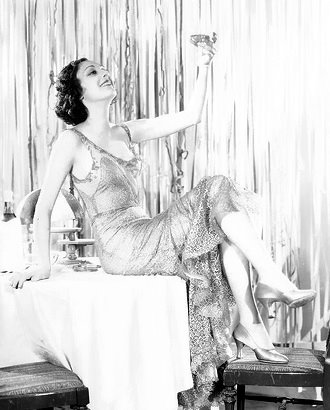
Ann Dvorak as Molly Louvain
The best thing with Molly Louvain is the theme song written by Val Burton and Will Jason, When We're Alone or Penthouse Serenade as it often is called. An absolutely beautifully written song with clever lyrics. Please listen to this fine rendition by The Arden-Ohman Orchestra with vocal stylings by Frank Luther.
Today's last entry is They Learned About Women (1930) Real-life vaudevillians Gus Van and Joe Schenck, whose piano act carried them to fame in the Ziegfeld Follies footlights and on early-radio airwaves, headline this spirited 1930 musical that combines World Series heroics with the quest for romance (The Broadway Melody’s Bessie Love plays the female lead). This is a unique opportunity to see vaudeville veterans Van and Schenck in action. It's their only full length feature and also their last joint effort on film. Six months after the premiere Schenck died of a heart attack in Van's arms at the age of 39. During production it changed title several times like the ad below indicates. Other working titles were "Take It Big" and "Playing The Field". They Learned About Women served as blueprint for Take Me Out To The Ball Game (1949)
Publicity material for They Learned About Women
Warner's are on a roll! Will there be even more?

Thursday, December 3, 2009

An early talkie Christmas!

Today Warner Brothers announced the release of some really interesting titles in the fantastic Warner Archives series. In this latest batch we find some absolute necessities for the early talkie fan. Below I have selected seven titles I would buy at once if I resided in the US (which I don't) as the Warner Archives series is only available to film fans in the US.

The Hollywood Revue Of 1929 A very prolific movie, instrumental to the movie revue and musical craze of 1929-30. It is unique in many ways. It was the first attempt at filmed musical revue and features all your favorite MGM stars except Lon Chaney and Greta Garbo. It is also the only movie in which you get a good glimpse of Queen Norma Shearer and John Gilbert in living color. Cliff Edwards is performing the original version of Singing in the Rain, a song that was written for this film. Be sure to get a copy of it!

Next in line and equally important is the first all color talkie ever made, On With The Show! (1929) Unfortunately, all color prints are lost since long but at least the film survives intact. Among the many great songs we find Am I Blue performed by Ethel Waters.

"With unpaid actors and staff, the stage show Phantom Sweetheart seems doomed. To complicate matters, the box office takings have been robbed and the leading lady refuses to appear. Can the show be saved?"

A personal favorite I have mentioned many times on this blog. Rio Rita (1929) was the biggest hit of the 1929-30 season. This is the 1932 re-release print I wrote about in my last post, but until the original 1929, 140+ minute version resurfaces it will have to do.

Rio Rita helped put RKO on the map and paved the way for a string of no less than 22 Wheeler & Woolsey comedies between 1929 and 1937. It was much thanks to the success of those early films RKO was able to give us all the fantastic Fred & Ginger movies during the later part of the 1930's. Say thanks by getting yourself a copy of Rio Rita, the film that started it all!

We move on to two movies which both opened in December 1929. The first It's A Great Life (1929) Starring Rosetta & Vivian Duncan (in their only full length feature) and Lawrence Gray. A very typical 1929 musical including three great Technicolor sequences. Let's hope the last of them hasn't been cut like it has been on several occasions when aired on TCM.

Sally (1929) Ziegfeld superstar Marilyn Miller in her first film of three. Sally was a no expenses saved all color talkie which used the biggest indoor sets ever built to that date. Sadly the color prints are lost except for a fragment of four minutes I hope is included in this Warner Archive print.

Show Girl In Hollywood (1930) See Alice White play Dixie Dugan. A totally charming musical showing how a musical talkie was made from the inside. Don't miss it! The final reel was originally in color but now we'll have to do with Alice White in grayscale.

Golden Dawn (1930) Another all color talkie musical. Golden Dawn is probably the most bizarre musical ever made and deserves a post of its own. Set in German East Africa we get Noah Beery in blackface singing a strange song to his whip. Marion Byron beating up her beau Lee Moran etc. Good score and wonderful songs by Stothart and Hammerstein but it stays a very peculiar picture.
More on Golden Dawn soon, stay tuned...

Monday, March 9, 2009

My Talkie Lair

Raquelle of Out Of The Past urged her fellow bloggers to take pictures of their entertainment centers. Naturally I have to answer to such an urge. Here goes!

Here's the center itself. My TV-set is an old Philips Widescreen I bought in France 10 years ago. I thought of changing it for a flat screen when it brakes down but it's still as good as new so I guess that will have to wait. All my friends have had flat panel TV's in road sign sizes for years but I don't care, since the talkies I watch often are quite flaky in quality and only have glorious mono sound. The toy stove is not mine. It belongs to my son who was watching a French "dessin animeé" about insects when this picture was taken earlier today. 
Let's pass through the kitchen and look what we find on the other side.

This is where I make up my stuff and where I am right now. When the picture was taken I was not. Most of my silents and talkie collection is kept in unsexy albums like the red one that rests on a pile of junk to the left. As most films from the 1925-35 period awaits DVD releases you have to collect copies on home made DVD's from all over the world. Let's turn around instead and watch where I keep some of my officially released stash...

I have DVD's hidden in every space imaginable in my appartment, but this is the core of my collection. Mostly classic movies and European art films like Bergman and Fellini. 
I have one thing in common with Raquelle here... We are both labeling our beloved VHS casettes with plain white labels on the short end of the box. I don't know if this is common practice. I don't know anyone else who does it except for me and Raquelle. It saves space so I thought it was a good idea back in the 80's when I started to do it. I bet Raquelle came up with the same idea.

On the other side there's more VHS and some records I'm probably ashamed of having in my collection...

When I am seated at my desk this is what I see...Records and occasionally some sunshine. Ooops! a pair of shorts! OK I'll leave those for documenatry values. Swell!

My next post will be up in a few days. It will be a recycled but slightly expanded version of my erlier Swedish post about Lawrence Gray, a forgotten talkie personality and singer of unforgettable songs.


Sunday, February 8, 2009

It was 80 years ago today...


Broadway Melody, the first talkie musical had its celebrity premiere February 1st 1929 at Grauman's Chinese Theatre in Hollywood. The public premiere was held a week later, February 8th in New York, making it exactly 80 years ago today. Historically, Broadway Melody is a very important movie, not only for movie musical lovers but for numerous other reasons as well.

Broadway Melody was the first talkie to have a score and songs specifically written for it by a songwriting team set up by a major studio. Former vaudeville artist Artur Freed wrote the lyrics and former tailor shop owner Nacio Herb Brown wrote the music. The two were hired by MGM in 1928. The story was written by Edmund Goulding and adapted for the screen by Sarah Y. Mason, Norman Houston and James Gleason. Harry Beaumont directed the picture. The three leading roles were played by Bessie Love, Anita Page and Charles King. Broadway Melody was shot on 26 days between September and November of 1928.

Bessie Love & Anita Page

At this time MGM only had one operable soundstage so Broadway Melody had to share space with the studio’s first all-talking dramatic film, The Trial of Mary Dugan (1929), starring Norma Shearer. During the morning and early afternoon, the Trial of Mary Dugan company would use the studio, and in the evening, the Broadway Melody cast and crew moved in.

Typical talkie set 1929

This is the original backstage musical and it tells the story of Hank and Queenie Mahoney, a sister act arriving in New York hoping to hit it big time on Braodway. Bessie Love plays Hank, the pepperpot of the sisters who's also running the act. She is in love with Eddie Kerns, an upcoming songwriter (Charles King) who eventually falls for Queenie, the younger sister (Anita Page). Rather than hurt her sister, Queenie starts running around with a scummy playboy. The truth about who loves who finally comes out and Hank backs off in a very memorable heart-breaking scene, giving up Eddie and the act, and clears the way for Queenie and Eddie.

The story is said to be loosely modeled on the life of The Duncan Sisters who also were sought after to play the leads in the movie. But for various reasons the leads instead went to Bessie and Anita. The Duncan's later got a consolation price in It's A Great Life which had a very similar plot but lacked the novelty value of its predecessor. It's A Great Life was to be The Duncan's only full length feature.

Bessie Love was nominated for an academy award for best actress in a leading role but lost to Mary Pickford in Coquette. Broadway Melody had three nominations and won the Oscar for best picture 1929-30.

Let's take a look at one interesting scene.
The movie starts off with a firework of sound at a Tin Pan Alley music publishing company. If we look closely we can see the composer Nacio Herb Brown at the piano and a glimpse of Arthur Freed as a spectator towards the end of the clip. The sound is noisy, the cutting is rough but the use of sound like this in a motion picture was something completely new to the audience.


The scene was orchestrated by the pioneering and inventive sound engineer Douglas Shearer who by no means was an experienced sound man at this time. Shearer was running the sound department at MGM as a one man operation and this was his third assignment. Maybe it tells something about MGM's look at the new talkie fad.

A proud Douglas Shearer with his 1930 Oscar for The Big House

Douglas Shearer was Queen Norma's older brother who came down to Hollywood from Canada one day to visit his sister. Norma quickly got him a job at MGM and almost by mistake he was chosen to set up the brand new sound department. As talking pictures was something new both to Shearer and to the world he had to be resourceful. In what seems to be a couple of weeks Shearer more or less invented how to make talking pictures.

A color frame from The Painted Doll number

Originally the film included a brief color sequence. The Wedding Of The Painted Doll, a ballet number sung by James Burroughs off camera. The sound was fine, however the dancers were not well rehearsed so Beaumont ordered a retake, but instead of letting the orchestra work overtime Douglas Shearer came up with the idea to use the soundtrack of the first take and let the dancers dance to the music coming from a loudspeaker. No one had an idea that the sound actually could be stiched on afterwords. Douglas Shearer had just invented the audio dubbing, a technique used in almost every single motion picture made ever since.

Broadway Melody is available on DVD

Tuesday, November 11, 2008

Dancing Lady (1933)


As I have pointed out earlier, many of the early talkies has never been released in any form, not even on VHS. Here is one that luckily is available to us. Dancing Lady was MGM’s run at big budget musicals inspired by Warner’s success with both 42nd Street and Gold Diggers Of 1933. I think there might be a few reasons why this particular movie has been graced with a second life on DVD. I suppose the fact that it’s the movie debut of Fred Astaire really helped. Astaire plays himself as a specialty dancer and Crawford’s partner in the final number, but as a whole he doesn’t have that much to do and doesn’t stick out at all. Maybe he also had to under do his part to level with Crawford’s somewhat limited dancing abilities compared to his excellence.

Other reasons for a DVD release? Dancing Lady is the fourth pairing of eight for Crawford and Gable, perhaps not the best, but an important one. It’s also the screen debut of Nelson Eddy. We get The Three Stooges in minor roles working as stagehands slapping around as usual, and it’s the second last movie Winnie Lightner ever did. Voilà! I think everything mentioned above (save for Winnie’s part) helped making it to DVD.

The movie is based on the novel Dancing Lady by James Warner Bellah, serialized in the Saturday Evening Post during spring 1932. The Storyline is quite simple, Crawford plays Janie Barlow, a burlesque dancer who not only struggles to succeed, but strives for success and is dreaming of making it on Broadway. She’s being pursued by a rich boyfriend, Tod Newton (Franchot Tone), but is blinded by the footlights of Broadway. The film was originally to have starred Robert Montgomery as Newton but when filming was to begin Montgomery was busy elsewhere. The Jet-setter boyfriend helps Janie out by getting her into a show directed by tough guy director Patch Gallagher (Gable) who has a rough exterior but a kind heart. His hair constantly in a mess, ranting around muttering "save it, save it!" Naturally he tries hard not to show he's softer than his appearance. When he sees Janie’s talent and perseverance, he gives her the "top spot" in his show “The Dancing Lady”. Of course, he's attracted to her, too, and she to him. But then there’s the rich boyfriend lurking in the wings. Crawford is always charming and full of pep, even though I think she sometimes looks like Garbo's twin sister, let go a little more talkative and less mysterious.


Janie (Crawford) rehearsing in front of Gallagher (Gable) for the first time. The song Dancing Lady is performed by Art Jarrett.

Dancing Lady may not be the greatest musical of the 30’s, not even the greatest musical of 1933 but I like it and it’s fun to see Gable and Crawford in action even though a musical isn’t exactly their element. There are some good songs. Notably this one, All I Have Is Yours, beautifully sung by Art Jarrett (I don't know if Crawford's humming was dubbed or not):


As a back stage musical, Dancing Lady contains very little music and dancing apart from the finale which in every way makes up for this shortcoming. It is a visually stunning, no expenses saved, feast for the eyes, containing animation, all sorts of trickery and ending up in a kaleidoscopic carousel of chorines. Swell! Easily my favorite 10 minutes of the movie. The theme for the finale is a bit strange though. Let’s Go Bavarian seems a bit over the top in the year of 1933 when Hitler came to power, Crawford in valkyrie-braids and Astaire in lederhosen is almost scary. "Here in Bavaria, we'll take good care of ya'!" Look for yourself:


High Ho! The Gang's all here! Let's have pretzels! Let's have beer!

As you can see in the above clips, Dancing Lady is visually very elaborate. Cinematographer Oliver T. Marsh deserves a mention. Marsh did quite a few of Crawford's 30's movies including Letty Lynton and Rain. I should say that the visuals are the most important quality of the movie. All the sets are very art deco from start to finish, culminating in the finale which is a mind-blowing feu d'artifice. Apart from the finale I'd like to point out another sequence I really liked. In the beginning of the movie Crawford is chasing Gable around town desperate for an audition. This is shown in a flimsy but very nice montage that brings the editing techniques of the silent era to mind. As a whole, Dancing Lady is a refreshing picture with quite a few memorable moments.

Thanks to LordWham, JozefSterkens and Liftoffgirl for the clips.

Wednesday, October 8, 2008

Dust or DVD?

We all know how hard it can be to find odd movies on DVD. Well, I must admit there are great releases both here in Europe and most notably in the US. There is however one particular period that apparently is far too odd (or far out) to get good releases on either continent. The early talkies, my pet subject almost seems to be a forgotten era all together. When described in books or by film critics the movies from this particular period is often described as static, dull, racist or simply too bad to be taken seriously. Well, I don’t agree. I think this common misconception very well may be the main reason so few of these movies are released to the public. Therefore I have made a little list of which early talkies I believe must get a general DVD release in the near future.

The Singing Fool (1928) The follow up to the Jazz Singer, a part talking, part singing, not much dancing Vitaphone triumph and one of the biggest moneymakers during the 20’s. Apparently it survives intact with both picture and sound elements in good working order. Where is the “80th anniversary special 3-disc edition” of this? It was a much bigger hit than the Jazz Singer (which has a really nice box-set, since it is considered the first talking picture). A follow up would be appropriate.

Eddie Cantor - The Goldwyn Years (1930-34) Whoopee!, Palmy Days, The Kid From Spain, Roman Scandals and Kid Millions, This bunch once was out on Laserdisc in the early 90’s but has never been released in any form since. These five films are comedy classics. They are in every way as good as the Marx Bros films of the same period. However, I know there is a problem. Eddie always has a few scenes in blackface in all of them. I guess this can be a reason not to release them in a time when everything public has to be politically correct. I am not American so I may not understand these issues completely but for Eddies sake, it was almost 80 years ago, times were different back then and Eddie proved to be a good person all his life, it’s time to honor him with a release of his best work.

Rio Rita (1929) The 1929 original 140 minute version. This was the big Christmas blockbuster of 1929 and a grandiose spectacular it was indeed. Music, song, dance and comic relief from Wheeler & Woolsey. What more can one ask for? The common version of this film is the badly cut 1932 re-release with many of the best numbers, including the Kinkajou cut. I have quite reliable information from different sources about an existing print of the 1929 European release. So a little research in that direction might give us a complete Rio Rita to feast our eyes Swell!

Follow Thru (1930) This is said to be one of the best preserved two- strip Technicolor films of this period. Follow Thru has been restored from the original negatives by the UCLA some ten years ago. This is frustrating when all you can get your hands on is a 14th generation copy of a VHS made in Japan back in 1984, you can imagine the blur. I haven’t seen the restored version since it’s only shown on remote festivals on what seems to be the other side of the world. DVD – Now!

Paramount On Parade (1930) Also a restored film which is almost intact, apart from some color footage that had to be presented in b/w. I can’t see the use in restoring a film only to keep it locked up. Sadly, Paramount On Parade is hardly ever shown at all. The restored print runs 102 minutes whether the print in circulation among collectors is a totally mutilated 77 minute (sometimes even shorter) version with no color at all made for TV in the early 50’s. Paramount On Parade also exists in different languages. It’s especially interesting for me since it’s probably the only early talkie that was made in a Swedish version. Some of the Swedish footage have survived and could serve as bonus material. I think there is existing footage from the Spanish version as well.

Glorifying The American Girl (1929) The same goes for this “milestone”. It has been restored to its former glory but is naturally collecting dust on a shelf somewhere instead of being given a second life on DVD. OK it’s not a great movie, but it has really good bits in it. We get to see what a Ziegfeld Follies extravaganza could have looked like, in color, with Ziegfeld himself supervising. In my book that is far more interesting than collecting dust in the dark, unseen by millions…

These are only a few of all the movies that could change the common point of view that the early talkies are something to forget about rather than to celebrate.
Related Posts with Thumbnails