
 The Show Of Shows (1929) was Warner's contribution to the revue craze that had begun a few months earlier with MGM's Hollywood Revue. However, this revue is probably the least magnificent of them all. It's incredibly stagy and drags on for just over two hours. All of it but the prologue was originally in color but the only color sequence still present in most prints is the Chinese Fantasy featuring Nick Lucas and Myrna Loy. I have heard rumors of more existing color footage but I have never seen any of it. Winnie Lightner's rendition of Singing In The Bathtub surrounded by a troupe of all male bathing girls is probably the most memorable number from it.
 So Long Letty (1929) This is a must for all of us fans of Charlotte Greenwood and it's her talkie debut. There are actually two So Long Letty movies based on the same play by Oliver Morosco and Elmer Harris. The original play opened at the Broadway Shubert Theatre in 1916. Charlotte Greenwood did Letty on stage and the role was something of a breakthrough for her. In the first movie version made in 1920, Greenwood was overlooked and the role instead went to Grace Darmond. I guess Charlotte may have been located at the east-coast at the time. The 1920 version is still very interesting as it is one of Colleen Moores earlier pictures. As far as I know it's believed to be lost, like so many other of Colleen's movies are.
Both movies are pure farce. The basic plot is a wife-swapping game. Two couples are next door neighbors. Although Harry loves his sweetly domestic wife Gracie, sometimes he longs for somebody a little more festive. On the other hand, Tommy wants nothing more than a lot of well-cooked meals while his spouse, Letty would rather go dancing. The two men get together and decide they'd be better off if they switched wives and work on encouraging their better halves to get divorces. But Letty and Grace catch on to their plan and spoil it by suggesting a one-week trial. During that week, they treat their temporary husbands so abominably that the men are more than glad to have their original wives back. The 1920 version sticks fairly close to the Oliver Morosco play on which it was based. The talkie version directed by Lloyd Bacon adds a few plot twists, is slightly modernized and contains some catchy songs. Here's Charlotte in one of them, My Beauty Shop.
So Long Letty (1929) This is a must for all of us fans of Charlotte Greenwood and it's her talkie debut. There are actually two So Long Letty movies based on the same play by Oliver Morosco and Elmer Harris. The original play opened at the Broadway Shubert Theatre in 1916. Charlotte Greenwood did Letty on stage and the role was something of a breakthrough for her. In the first movie version made in 1920, Greenwood was overlooked and the role instead went to Grace Darmond. I guess Charlotte may have been located at the east-coast at the time. The 1920 version is still very interesting as it is one of Colleen Moores earlier pictures. As far as I know it's believed to be lost, like so many other of Colleen's movies are.
Both movies are pure farce. The basic plot is a wife-swapping game. Two couples are next door neighbors. Although Harry loves his sweetly domestic wife Gracie, sometimes he longs for somebody a little more festive. On the other hand, Tommy wants nothing more than a lot of well-cooked meals while his spouse, Letty would rather go dancing. The two men get together and decide they'd be better off if they switched wives and work on encouraging their better halves to get divorces. But Letty and Grace catch on to their plan and spoil it by suggesting a one-week trial. During that week, they treat their temporary husbands so abominably that the men are more than glad to have their original wives back. The 1920 version sticks fairly close to the Oliver Morosco play on which it was based. The talkie version directed by Lloyd Bacon adds a few plot twists, is slightly modernized and contains some catchy songs. Here's Charlotte in one of them, My Beauty Shop.
Let me see your bald spot - it fascinates me!
We move on to some pre-code grit with Ann Dvorak, one of our favorite pre-code actresses who just a few years earlier had been one of MGM's leading chorus girls and dance director Sammy Lee's assistant. In the spring of 1932 Ann Dvorak made three movies that definitely made her go from chorus girl to character actress. Scarface, The Crowd Roars and The Strange Love of Molly Louvain. The last of them is now finally out on DVD. Directed by Michael Curtiz (Casablanca), it is an odd story about a woman torn between different but equally bad guys. Lee Tracy is memorable as the reporter who tries to save poor Molly from the gutter.
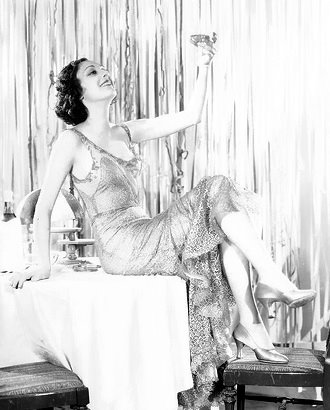 The best thing with Molly Louvain is the theme song written by Val Burton and Will Jason, When We're Alone or Penthouse Serenade as it often is called. An absolutely beautifully written song with clever lyrics. Please listen to this fine rendition by The Arden-Ohman Orchestra with vocal stylings by Frank Luther.
Ann Dvorak as Molly Louvain
Today's last entry is They Learned About Women (1930) Real-life vaudevillians Gus Van and Joe Schenck, whose piano act carried them to fame in the Ziegfeld Follies footlights and on early-radio airwaves, headline this spirited 1930 musical that combines World Series heroics with the quest for romance (The Broadway Melody’s Bessie Love plays the female lead). This is a unique opportunity to see vaudeville veterans Van and Schenck in action. It's their only full length feature and also their last joint effort on film. Six months after the premiere Schenck died of a heart attack in Van's arms at the age of 39. During production it changed title several times like the ad below indicates. Other working titles were "Take It Big" and "Playing The Field". They Learned About Women served as blueprint for Take Me Out To The Ball Game (1949)


Publicity material for They Learned About Women
Warner's are on a roll! Will there be even more?


 A personal favorite I have mentioned many times on this blog.
 .jpg)


 Posts
Posts


