Showing posts with label Warner Bros. Show all posts

Tuesday, December 8, 2009

An early talkie Christmas - Part 2

Just when we thought we had seen it all Warner Archive is releasing yet another batch of four totally brilliant early talkies to add to your wish list in the "must have" section.
The Show Of Shows (1929) was Warner's contribution to the revue craze that had begun a few months earlier with MGM's Hollywood Revue. However, this revue is probably the least magnificent of them all. It's incredibly stagy and drags on for just over two hours. All of it but the prologue was originally in color but the only color sequence still present in most prints is the Chinese Fantasy featuring Nick Lucas and Myrna Loy. I have heard rumors of more existing color footage but I have never seen any of it. Winnie Lightner's rendition of Singing In The Bathtub surrounded by a troupe of all male bathing girls is probably the most memorable number from it. So Long Letty (1929) This is a must for all of us fans of Charlotte Greenwood and it's her talkie debut. There are actually two So Long Letty movies based on the same play by Oliver Morosco and Elmer Harris. The original play opened at the Broadway Shubert Theatre in 1916. Charlotte Greenwood did Letty on stage and the role was something of a breakthrough for her. In the first movie version made in 1920, Greenwood was overlooked and the role instead went to Grace Darmond. I guess Charlotte may have been located at the east-coast at the time. The 1920 version is still very interesting as it is one of Colleen Moores earlier pictures. As far as I know it's believed to be lost, like so many other of Colleen's movies are. Both movies are pure farce. The basic plot is a wife-swapping game. Two couples are next door neighbors. Although Harry loves his sweetly domestic wife Gracie, sometimes he longs for somebody a little more festive. On the other hand, Tommy wants nothing more than a lot of well-cooked meals while his spouse, Letty would rather go dancing. The two men get together and decide they'd be better off if they switched wives and work on encouraging their better halves to get divorces. But Letty and Grace catch on to their plan and spoil it by suggesting a one-week trial. During that week, they treat their temporary husbands so abominably that the men are more than glad to have their original wives back. The 1920 version sticks fairly close to the Oliver Morosco play on which it was based. The talkie version directed by Lloyd Bacon adds a few plot twists, is slightly modernized and contains some catchy songs. Here's Charlotte in one of them, My Beauty Shop.
Let me see your bald spot - it fascinates me!
We move on to some pre-code grit with Ann Dvorak, one of our favorite pre-code actresses who just a few years earlier had been one of MGM's leading chorus girls and dance director Sammy Lee's assistant. In the spring of 1932 Ann Dvorak made three movies that definitely made her go from chorus girl to character actress. Scarface, The Crowd Roars and The Strange Love of Molly Louvain. The last of them is now finally out on DVD. Directed by Michael Curtiz (Casablanca), it is an odd story about a woman torn between different but equally bad guys. Lee Tracy is memorable as the reporter who tries to save poor Molly from the gutter.
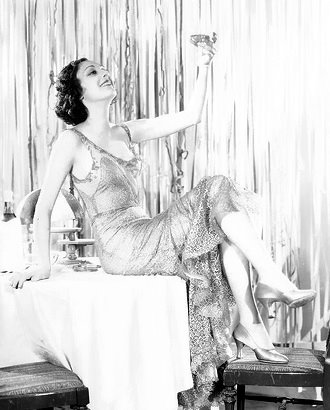
Ann Dvorak as Molly Louvain
The best thing with Molly Louvain is the theme song written by Val Burton and Will Jason, When We're Alone or Penthouse Serenade as it often is called. An absolutely beautifully written song with clever lyrics. Please listen to this fine rendition by The Arden-Ohman Orchestra with vocal stylings by Frank Luther.
Today's last entry is They Learned About Women (1930) Real-life vaudevillians Gus Van and Joe Schenck, whose piano act carried them to fame in the Ziegfeld Follies footlights and on early-radio airwaves, headline this spirited 1930 musical that combines World Series heroics with the quest for romance (The Broadway Melody’s Bessie Love plays the female lead). This is a unique opportunity to see vaudeville veterans Van and Schenck in action. It's their only full length feature and also their last joint effort on film. Six months after the premiere Schenck died of a heart attack in Van's arms at the age of 39. During production it changed title several times like the ad below indicates. Other working titles were "Take It Big" and "Playing The Field". They Learned About Women served as blueprint for Take Me Out To The Ball Game (1949)
Publicity material for They Learned About Women
Warner's are on a roll! Will there be even more?

Thursday, December 3, 2009

An early talkie Christmas!

Today Warner Brothers announced the release of some really interesting titles in the fantastic Warner Archives series. In this latest batch we find some absolute necessities for the early talkie fan. Below I have selected seven titles I would buy at once if I resided in the US (which I don't) as the Warner Archives series is only available to film fans in the US.

The Hollywood Revue Of 1929 A very prolific movie, instrumental to the movie revue and musical craze of 1929-30. It is unique in many ways. It was the first attempt at filmed musical revue and features all your favorite MGM stars except Lon Chaney and Greta Garbo. It is also the only movie in which you get a good glimpse of Queen Norma Shearer and John Gilbert in living color. Cliff Edwards is performing the original version of Singing in the Rain, a song that was written for this film. Be sure to get a copy of it!

Next in line and equally important is the first all color talkie ever made, On With The Show! (1929) Unfortunately, all color prints are lost since long but at least the film survives intact. Among the many great songs we find Am I Blue performed by Ethel Waters.

"With unpaid actors and staff, the stage show Phantom Sweetheart seems doomed. To complicate matters, the box office takings have been robbed and the leading lady refuses to appear. Can the show be saved?"

A personal favorite I have mentioned many times on this blog. Rio Rita (1929) was the biggest hit of the 1929-30 season. This is the 1932 re-release print I wrote about in my last post, but until the original 1929, 140+ minute version resurfaces it will have to do.

Rio Rita helped put RKO on the map and paved the way for a string of no less than 22 Wheeler & Woolsey comedies between 1929 and 1937. It was much thanks to the success of those early films RKO was able to give us all the fantastic Fred & Ginger movies during the later part of the 1930's. Say thanks by getting yourself a copy of Rio Rita, the film that started it all!

We move on to two movies which both opened in December 1929. The first It's A Great Life (1929) Starring Rosetta & Vivian Duncan (in their only full length feature) and Lawrence Gray. A very typical 1929 musical including three great Technicolor sequences. Let's hope the last of them hasn't been cut like it has been on several occasions when aired on TCM.

Sally (1929) Ziegfeld superstar Marilyn Miller in her first film of three. Sally was a no expenses saved all color talkie which used the biggest indoor sets ever built to that date. Sadly the color prints are lost except for a fragment of four minutes I hope is included in this Warner Archive print.

Show Girl In Hollywood (1930) See Alice White play Dixie Dugan. A totally charming musical showing how a musical talkie was made from the inside. Don't miss it! The final reel was originally in color but now we'll have to do with Alice White in grayscale.

Golden Dawn (1930) Another all color talkie musical. Golden Dawn is probably the most bizarre musical ever made and deserves a post of its own. Set in German East Africa we get Noah Beery in blackface singing a strange song to his whip. Marion Byron beating up her beau Lee Moran etc. Good score and wonderful songs by Stothart and Hammerstein but it stays a very peculiar picture.
More on Golden Dawn soon, stay tuned...

Sunday, November 1, 2009

Cut musical numbers in 1930


The first life of the Hollywood movie musical ended in the summer of 1930. The movie goers were fed up with backstage dramas and movies built around a generous bouquet of songs. The songs could be great but plots were often thin and it was hard to tell the difference between two films. The studios were taken by surprise by this sudden change in behaviour. They were convinced they had found the ultimate form of entertainment. Something quickly had to change, it was inevitable. The musicals that were already made waiting for release were put on hold, in hope the reluctancy towards musical films would wear off. Many of the musicals in pre-production, or projects that were planned for the 1930-31 season were canceled. The most ill fated and expensive of the aborted projects was of course MGM's The March Of Time which has a post of it's own.

Some studios, most notably Warner Bros, came up with a third solution: They simply cut out as many songs as possible turning a would be musical into a comedy. Sometimes it almost worked, mostly it didn't. This is the reason many movies of this period are very short. If a 1930 movie end up with a running time of something between 60 or 70 minutes one can be quite sure there were cuts, most certainly songs.

This was the case with First National/Warner's Top Speed that opened almost songless late August 1930. Joe E. Brown and Jack Whiting play two clerks who poses as rich playboys at a swanky summer resort. (The movie was shot almost entirely at the Norconian Resort). One of them falls in love with a millionaire's daughter who has a very disapproving father, until he wins, through fate and fortune, the Big Boat Race, in the vessel owned by his sweetheart's father.

The Norconian Resort in Top Speed 1930

Top Speed had been shot as a full musical containing ten songs, some of them quite big production numbers. When it opened only three songs were left. With a running time of 73 minutes my guess is that the seven cut songs equals about 20 minutes of footage. This treatment of course paved the way for comedians like Joe E. Brown who had three musicals turned into comedy in 1930. But for other performers it was a sad experience. Singers like Bernice Claire had many of her best moments cut, ending up on the cutting room floor. Look at this very fine example of how this was carried out:
Bernice is just going to sing a fine song to her beau Jack Whiting, "As Long as I Have You and You Have Me". The music cue fades up, but just as she is about to open her mouth... Cut!


Earlier blockbusters were also tampered with at this time. Rio Rita, the big Christmas success of 1929 was re-released in 1932 in what was called a "modernized version". The modernization consisted of cut musical numbers. Rio Rita was a mammoth picture running in "massive 14 reels" which means that it had a running time of about 140 minutes. With the coming of the talkies a standard running time of 8-10 reels was quickly established. The silent movies had often been much more extravagant and extreme running times were common during the silent era. Rio Rita was one of those really extravagant movie operettas with the distinction it also was hugely successful. The earliest talkies aged very quickly, Rio Rita was no exeption. With it's rather slow pace, it had in many ways the form of a silent movie. To make this giant work wonders again something had to be done.

The missing pirate girls in the 1932 version of Rio Rita

It's been said that the cuts to Rio Rita which formed the 1932 re-release version were done by the hand of none other than David O. Selznick, but whether true or not, the fact remains that the film was slashed by somewhere between four and five reels in length, amounting to at least 40 minutes of deletions. The Rio Rita seen today is thus about two thirds of what it once was. Let's examine what we have and see if we can find any obvious cuts:

Just as the color portion begins we find one of the ugliest cuts. The anonymous singer has just finished crooning when we can see an acrobat act entering the stage. We also see a mass of chorus girls towering at the back of the stage. Cut!


Luckily most of the soundtrack to the 1929 version has survived. It's in terrible shape, but after some heavy filtering the truth emerges, the missing two and half minutes are there:


Another cut in Rio Rita is a giant production number of Sweetheart We Need Each Other. Look first at the 1932 version, just after the risque hint of male kissing both couples fall overboard... Cut!:


Then listen to what is happening on the 1929 soundtrack:


I'm positive I'm not the only one who would like to see that number.
Let's hope that 1929 original version of Rio Rita resurface some day soon. My firm belief is that it has just been replaced or mislabled, sitting on a shelf in an institution somewhere. The latest public showing of the original Rio Rita I have heard about took place around 1980.

Let's end this post with one of the three songs from Top Speed that was considered too good to cut. Laura Lee and Joe E. Brown perform Knock Knees by Al Dubin and Joseph Burke. The dance director is of course Larry Ceballos.

Wednesday, May 27, 2009

Alice White - Showgirl In Hollywood

I have mentioned Alice White several times before in my posts, so I think it's about time she had her own entry. Alice was born in Paterson, New Jersey in 1904 (some sources say she was born in 1907). Still a child when her mother died she moved to Hollywood to live with her grandmother. After college she started to work as a secretary and occasional script girl in different productions. I guess it was a job like any other. Most people living in Hollywood worked in the movie business at this time and still does. One could easily say the movie studios in Hollywood were like the steel mills or textile factories of other towns.

Alice got lucky to work as a script supervisor for well known director Josef von Sternberg in the 1926 movie A Woman Of The Sea, made for Charles Chaplin Productions. Von Sternberg eventually fired her and sent her back to the office. According to von Sternberg she wasn't serious enough for the job. I guess it was because of this incident she was sent in to have a talk with Chaplin himself. Chaplin who had a soft spot for young perky girls liked her style and thought she would do better in front of the camera than behind. Chaplin pulled some strings and got her to do bit parts in different productions starting with The Sea Tiger for First National Pictures in 1927.

In her seventh film, Gentlemen Prefer Blondes (1928), made for Paramount she finally got a leading role. This got her a real contract with First National who had decided they needed an "it-girl" of their own. The choice fell on Alice who indeed had much of Clara Bow's youthful pep but perhaps a little less of the "it". However, Alice's career didn't really want to take off in the silent world. Perhaps she wasn't a very good actress but she definitely had something. When Warner Bros bought the control of First National in September 1928 they decided to make Alice a talkie star. Her 15th picture, Hot Stuff (1929) was a part talkie and the 16th, Broadway Babies became her first 100% talkie. Alice White had finally found the missing part of her jigsaw puzzle. As Clara Bow's star fell with the advent of the talkies, Alice White's started to rise.

Broadway Babies was a smash! It tells the story of the "three Broadway musketeers" trying to break into showbusiness. While Alice is more interested in the showbusiness part, her two musketeer friends, played by Marion Byron and Sally Eilers, are only in it to nab rich boyfriends. Alice eventually gets her break, a wealthy potential lover and bootlegger, but naturally she also have a real sweetheart waiting in the wings. Alice finally admits her love for her sweetheart to the wealthy bootlegger, and having a big heart he releases her, clearing the way for a happy ending. Let's take a look at Alice White strutting her stuff in the final number in Broadway Babies, The song is called Broadway Baby Dolls and was written by George W. Meyer and Al Bryan:


Alice's next big musical was Showgirl In Hollywood which I have shown a clip from in my post about the static talkie. It tells the story of Dixie Dugan a Broadway showgirl who is lured to Hollywood by the empty promises of a pompous film director. Well in Hollywood she meets and becomes friends with Donny Harris (played by Blanche Sweet), a once popular film star. Dixie finally gets her break but ruins Donny's chances for a comeback. Devastated, Donnie attempts suicide but is saved. Dixie realizes her selfishness and convinces the studio bosses to "go on with the picture", for Donny's sake. Showgirl In Hollywood is in many ways a remarkable picture. It was adapted from two quite risqué novels written by J.P. McEvoy. Show Girl (1928) and Showgirl In Hollywood (1929). It was the first all talking movie which actually showed what it was like to make a talkie rather than a stage production.

With the sucess of the movie the McEvoy novel was turned into a comic strip where Dixie Dugan was modeled after Alice White's character in the movie but with Louise Brooks' hair style. The comic strip was to bacome the most well known version of the Dixie Dugan character.
Let's take a look at the final number from Showgirl In Hollywood, a sequence originally filmed in Technicolor. The clip is also interesting as it features cameo appearences from several big Warner stars of 1930. The song is Hang On To A Rainbow written by Sam H. Stept and Bud Green. Being a no expences saved movie it was decided Alice White's singing voice wasn't good enough for this picture. Therefore she was dubbed by Belle Mann, a house vocalist at Victor who did quite a few recordings with the Ben Pollack Orchestra.


Alice continued to make sucsessful talkies until 1933 when she was victim to a tabloid press scandal having alleged affairs with two men at the same time, her then boyfriend, actor Jack Warburton, and her future husband Sy Bartlett. She made occasional movie appearances until the late fifties but her days as a movie star were then long gone. Alice White left us in 1983.

Fellow blogger Jeff Cohen of The Vitaphone Varieties once described Alice White like this: "From this vantage point --- so distant to 1929, perhaps the most enjoyment that can be had in watching Alice White in her surviving early talkies is that she's so utterly unlike the vast majority of her peers. There's neither forced raucous demeanor, nor transparent attempts to appear cultured and refined that just come across as creepy --- no, she's simply herself: good, bad or indifferent. Mostly indifferent. Never seeming to quite connect with her surroundings or co-stars, or even fully understanding the lines she's speaking for that matter, Alice White defies the odds and manages to charm rather than repulse or dismay, and that's no small feat."

Thursday, May 7, 2009

The static talkie

I feel there is a talkie myth I have to kill. Almost everything written concerning the early talkies states them as static, stagy, non moving, stale or plain dull. This seems to be the common view of what an early talkie is like. Well, I don't agree. I think there lies more behind the staginess than the fact that the camera was stuck in a booth and nailed to the floor. There are of course certain films that are incredibly static and non moving because they simply were bad films, done by directors that didn't know better. But there is a particular reason for the staginess in certain pictures no one seems to think of.

The most static of them all is probably Warner's Technicolor Extravaganza The Show Of Shows from 1929. It's almost unwatchable for a modern day audience, especially since all that is left of it is a foggy black and white print made for TV in the 50's. This seemingly endless, over two hour long revue belongs to the bunch of films that didn't age well. Let's take a look at the only preserved color sequence from it that has reached the public eye. A Chinese Fantasy or "Li-Po-Li" written by Edward Ward and Al Bryan, featuring Nick Lucas and Myrna Loy.


The staginess is frightfully apparent here because it is a stage presentation that has been filmed straight up. All the big revues of 1929-30 are static seen through the eyes of the modern day spectator, but to say that the early talkies as a whole had this problem is unfair. Imagine the effect a number like this had on a 1929 audience. I guess it must have been mindblowing, and in color too!

There are quite a few movies from 1929 that are very mobile and full of movement. Cecil B DeMilles Dynamite is one example. Let's take a look at a scene from another 1929 talkie, MGM's Their Own Desire, a film that opened December 27th 1929, two days prior to The Show Of Shows. We'll see Robert Montgomery picking up Norma Shearer at a very stylish party, all set to a beautiful and catchy tune, The Night Is Blue, written by Fred Fisher.


I don't find this especially static or stagy, It could have been filmed in the 1950's if you ask me. No, I think the static staginess should be looked upon as almost a genre in itself, a style that developed during the musical craze of 1929. After all, most of the early musicals were either revues or backstage dramas.

Four months later, in April 1930 Warner's takes the genre even further in Show Girl In Hollywood where perky Alice White is lured to Hollywood to make a talkie. What we have here is a meta-film. The audience are invited on the set. Quiet! Camera! Action!


I come to the conclusion that most musicals were basically filmed theatre because Broadway shows was something everyone wanted to see at the time. Putting a Broadway show on film was also simple and economic for the studios. With sets, songs and routines already worked out, the only thing left to to was to film it. They were meant to be stagy because they should give the audience the illusion of attending a Broadway show, not a movie.

The real movie musical came a few years later with Busby Berkeley's almost psychedelic settings in 42nd street. Berkeley was the first director who saw the musical genre as something uniquely cinematographic. His production numbers were always a feast for the eye, showing the audience things that never could be experienced when sitting in the stalls at a theatre. Let's take a look at the earliest example of Berkeley's work, it's not exactly as psychedelic as his later numbers but not that static either. Stetson from Whoopee (1930) Ethel Shutta and the Goldwyn Girls are all over the place. (Thanks to Matt for the video)


Many of the earliest musicals are lovable and sweet in all their innocence and they often contains wonderful songs, some of them still sung today.
I end this post with a superb song from the wonderful 1934 movie Kid Millions. Eddie Cantor introduces Ann Sothern and George Murphy who sing the Burton Lane classic Your Head On My Shoulder. Not exactly an early talkie but an example of brilliant songwriting.

Related Posts with Thumbnails