Monday, August 24, 2009

To colorize or not?

It feels good to be back in business after a vacation in the tropics. I direct a heartfelt thanks to Raquelle who wrote a nice guestpost on The Trial Of Mary Dugan, Norma Shearer's first talkie during my absence. Thank you Raquelle!
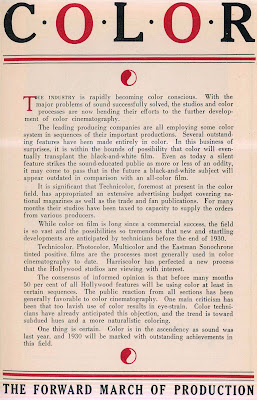
Let's stay a while in 1929. This week it will be 80 years since one of the biggest hits of 1929 opened. Gold Diggers Of Broadway, the second all color talkie ever made. Now more or less a lost film as only the two last reels or about 15 minutes of it still exists. During the spring and summer of 1929 color became an indispensable ingredient for all major studios starting in july when the first all color talkie On With The Show opened to mixed reviews. Color quickly became the next big thing after sound had come to stay. At the end of 1929 this ad was published in many movie related magazines to further emphasize the importance of adding color to the movies:
(Click on image for a larger view)
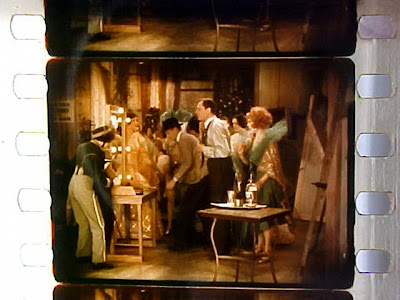
Sadly, no color prints have survived of On With The Show but bits and pieces are found here and there from time to time. The latest find from it was a 20 second snippet found in a toy projector when it was sold at an auction. Luckily someone recognized the strip of film and turned it in to the UCLA. Here's a frame from the color snippet found of On With The Show Isn't it sad the first talking picture ever made in color only exists in black and white save for a 20 second snippet? The second all color talkie doesn't even exist in black and white! Let's have a look at one of those fragments from Gold Diggers Of Broadway, an absolutely charming number, make way for Nick Lucas singing his signature tune Tip Toe Through The Tulips:
The third all color talkie was Warner's giant revue The Show Of Shows which I have discussed and shown a number from earlier. Only about 10 minutes of its over two hours still exists in color.
Let's move on to the fourth, Sally, opening in December of 1929 starring Marilyn Miller, a true superstar of the 1920's who was given the opportunity to turn her legendary stage performance of 1920 into a big budget movie in both sound and Technicolor. Miller's movie career was short, Sally was her first movie of three and the olnly one shot in color. Unfortunately only four minutes of Sally's all color splendor is left for us to enjoy but those four minutes are fabulous. In this clip the color fragment has been spliced in in the otherwise black and white print. Another interesting detail is that the original soundtrack disks have been used for the color footage but not for the rest of the movie. I don't know if this was done to further enhance the magnigifence of the fragment or if the old optical soundtrack from the 1950's transfer had to stick around for economical reasons. In either case here is The Wild Rose with music by Jerome Kern. This particular scene was the largest indoor set ever built in 1929
The oldest all color talkie that has survived is the fifth, The Vagabond King, starring Jeanette MacDonald and Dennis King. It has been restored but is very rarely shown. This leads to a question which is more of a dilemma really. We are all familiar with digital colorization of classic movies. This was a quite popular fad in the late 80’s when a lot of old movies were colorized this way. I didn't like it then and don't like it now. I will always prefer the original black and white versions of these movies no matter what.

Colorized Stooges
But what about movies originally made in color where the no color prints have survived to our days? Like On With The Show or Sally. Would it be completely wrong to colorize them? I’m not sure I think so. If proper research was carried out it might actually work. Maybe the results could turn out just fine.
Let’s say there is also surviving color fragments of the movie in question, like with Sally for instance. Would it be blasphemy to colorize the rest of it in the same hues and style? I think not. A movie shot in two-strip Technicolor should naturally be colorized in the limited spectrum two-strip color offered. Every measure should of course be taken to do the colorization as close as possible to the original. When releasing colorized movies on DVD a choice should naturally always be an option for those who prefer watching the "original" version. I'm not interested in any color if the movie originally was shot in black and white. Like Casablanca for instance, I know a colorized version was made of it 20 years ago. I still don't want to see it colorized. Two-strip Technicolor movies made "full color" isn't better. It's trying to make it something it never was. My question is simply if the movie originally was made in color, like On With The Show or Sally, and where no color prints has survived to our times, could a computerized colorization be seen as some sort of restoration? I my opinion it could, if it was done with a great sense for what the original could have looked like. What do you think?

Thursday, July 30, 2009

Guest Blogger Raquelle ~ The Trial of Mary Dugan (1929)

You are probably wondering where Professor Jonas has disappeared to. The self-proclaimed Talkie King is gallivanting around in exotic Thailand with his family, eating his way through the delicacies of the country and getting custom 1920's style suits fitted to his Swedish frame. Before he left, I promised Jonas that I would write a nice guest post for him to keep his blog active and so that he would have a nice little present waiting for him when he got back. Jonas recently sent me a copy of The Trial of Mary Dugan (1929), starring my favorite actress Norma Shearer so I thought I'd write about this film, as it's an important part of early talkie history. And here it is! Enjoy.
Raquelle - Out of the Past ~ A Classic Film Blog


The Trial of Mary Dugan (1929)
When you think of early talkies, musicals immediately come to mind. What better way to celebrate the marriage of light and sound on screen, than to have music, singing and dancing? In February of 1929, MGM premiered it's first all-talking picture Broadway Melody (1929). It was an extravagant film that spawned a series of sequels as well as a host of other pre-code musicals. While most hardcore film buffs know about Broadway Melody, they may not be as familiar with MGM's first all-talking dramatic film, The Trial of Mary Dugan (1929) which was released in April of 1929.

Now what doesn't come to mind when you think of early talkies is courtroom drama. But why not? A Courtroom drama is one of the best ways to take advantage of the talking picture form. The action during a trial is strictly dialogue-driven. Lawyers, judges, witnesses, jurors and defendants are all talking their way to the story's climax and resolution. While courtroom dramas were not common in silent film format, they were perfect fodder for live theater. When talking pictures became all the rave, film makers had a wealth of material in the form of plays, many of which came with a security blanket of having their own history of success.


When Paul Bern suggested making The Trial of Mary Dugan into a film, MGM Producer Irving Thalberg didn't want to take any chances. While the play had been a Broadway hit, he proceeded cautiously and had a shortened version of the film with select scenes shown to a live audience to gauge their reaction before he went full steam ahead with the film. When the audience reaction proved to be favorable, Thalberg went searching for the perfect actress to play the title role of Mary Dugan. He didn't originally have his wife, Norma Shearer, in mind although it was pretty clear that she was hungry for the part. At first Shearer's arch rival Joan Crawford was considered, but director Bayard Veiller didn't think she would suit the character's delicate nature. Thalberg suggested Shearer to Veiller and Veiller had her try out some of the dialogue on one of MGM's new sound stages. Shearer was absolutely terrified and after rehearsing one quick scene, Veiller shooed her off set. While Shearer thought she had failed, her petrified and distraught audition was just what Veiller was looking for. Mary Dugan is on trial for a murder and depending on the outcome of the case, she could either have been executed or set free. Fear and panic in her voice would be absolutely necessary to convey this on screen. So Norma Shearer was chosen and filming began.

I can't continue on with this post without talking about the sound elements of the film. Professor Jonas would wring my neck if I neglected this. The Trial of Mary Dugan was one of the first films, legendary sound and recording engineer Douglas Shearer (brother of Norma Shearer) worked on in his long career at MGM and in Hollywood. The film was shot almost simultaneously with Broadway Melody. This was also one of the few MGM films recorded with sound on discs. Throughout the movie there are breaks in the sound which serve as signals for theaters to change the records. Also, because the new sound equipment was so expensive, the film had to be shot as economically as possible. Filming only took 19 days and there were lots of long takes, few camera tricks and most of the film is shot in one courtroom.


If you are lucky enough to watch this rare film, you'll notice that MGM really experiments with sound. In one scene, an empty courtroom is suddenly flooded with loud and boisterous people. They are all excited about watching a salacious trial unfold and nearly trip over themselves to get to their seats and fill the courtroom with chaotic and raucous sound. Then the scene switches drastically to stark silence as Mary Dugan sits quietly in her jail cell waiting to be beckoned to the courtroom.

Norma Shearer brings her dramatics from her silent picture days but is a visual and aural delight in talkies. Her voice, tinged with a slight twinge of a Canadian accent, worked beautifully in talkies. If anything, her career skyrocketed when she successfully transitioned to talkies. She achieved more success in talkie form than she did with all of her silent pictures combined. The Trial of Mary Dugan helped earn Norma Shearer the title The First Lady of the Talkies.

The story of The Trial of Mary Dugan seems rather irrelevant to the film as an entity. It's main draw, at least for me, is what the film represents at a critical moment in the history of film. It showcases how film studios had to drastically change their approach to films as silent movies quickly faded into the past. These studios had to radically alter everything they did and forge ahead into unknown territory. However, what they had was the potential to make serious money as audiences were hungry for talking pictures. At this point, they could really afford to experiment and to make mistakes, because even a poor quality film, would make money simply off it's novelty. However, the film industry was still a business and they knew that they couldn't just throw money to the wind and had to make serious and clear-headed decision on those early talkies. While The Trial of Mary Dugan made $400,000 profit to Broadway Melody's $1.5 million, it was still a success and it demonstrated that MGM had a bright future in making all talking dramatic pictures.

~Raquelle for Jonas~

Thursday, July 16, 2009

A Lovely Award and vacation


I just got an award! Or two to be honest. The Lovely Blog Award was given to me by Lolita of Lolita's Classics and Louie of Give Me The Good Old Days

Thank You both! Your blogs are definitely among my favorites!

The rules: Accept the award and post it on your blog with the name of the person that gave it to you. Pass on the award to as many bloggers as you wish and let them know you chose them for the award.

As usual I'm the last one in line and everyone I know already got multiple awards, so I give this blog to all bloggers who writes about classic movies, silents, talkies, silents and talkies, film noir or particular stars of the classic era. Congratulations all of us! We make the blogosphere so much more interesting!


Right now I'm on an extended holiday in the far east, but will soon be back in business with more old news. One or two surprises might turn up during my absence though, so stay tuned.

Jonas
Related Posts with Thumbnails